
The Latest

Contribute. We love to hear your thoughts, your musings and your latest work. Please share with us!
Write a post

Mandatory Winter Tires and Poverty

Posted by Mark Holmgren on February 23, 2017

Yes, perhaps an odd title for a posting. I was on my way back home from meeting downtown with Alberta Government colleagues who also work in the poverty reduction arena and I heard this call-in show about winter tires, and more to the point, about whether or not winter tires should be mandatory.

They are mandatory in Quebec now, but even in some provinces without a mandatory requirement, more than 80% of drivers have winter tires. Not so in Alberta, where the percentage is just over 50%. I'm not sure about other low percentage-provinces, but here is what went through my mind.

Read More

Reducing Poverty: When Business is Engaged

Posted by the Tamarack Institute on February 3, 2017

This year marks the 20th anniversary of the Business Community Anti-Poverty Initiative (BCAPI), a progressive movement of the Saint John business community to help the city end generational poverty.

Read More

Securing fair employment and income: Where Living Wage and the Fight for $15 and Fairness intersect

Posted by Kirsti Battista on January 26, 2017

If adequately addressed, income security through employment can produce benefits and outcomes that cascade into other areas of a person’s experience of poverty and ultimately, an escape from poverty. For example, we know that having secure employment that includes a full range of benefits and a possible career path, also known as a “Standard Employment Relationship” is a key to escaping poverty (The Precarity Penalty (May 2015). When an individual can secure sustainable employment that upholds their rights as a worker and pays a living wage, it is more likely that the individual will experience positive effects associated with economic independence such as increased opportunities for civic and community participation, stabilization of health problems, and even increased life expectancy.

Read More

Watch Out for the Solution Bias

Posted by Mark Holmgren on January 26, 2017
Solutions are exciting, especially those you are a part of creating; but even if the ideas behind them were not your own, implementing a new solution is an intellectual turn-on. Sometimes there is an ego-boost when you are part of something on the “cutting edge.”

I wonder though, if at least some of the time solution-makers are so pumped about the potential of their new journey, they overlook pitfalls, obstacles and unintended consequences. I call this, solution-bias.
Read More

Movement Building and Collective Impact

Posted by Mark Holmgren on January 16, 2017

In an article written for Fast Company, Kaihan Krisppendorff, identifies four steps to building an effective social movement, which I have adapted below:

1. A community forms around a common goal or aspiration.
2. The community mobilizes its resources to act on the goal/aspiration.
3. The community crafts solutions and acts to deliver them.
4. The movement is accepted by (or actually replaces) the establishment or established regime of laws and policies (Source).

If you are involved in a collective impact initiative, these steps should resonate with you, in particular with the five conditions of collective impact. Krisppendorff doesn’t address shared measurement in his post about social movements, but successful movements are always about moving the needle and bringing about systems change to do so.

Read More

Adaptive Learning - A Pivotal Competence for Collective Impact

Posted by Chris Soderquist on December 19, 2016

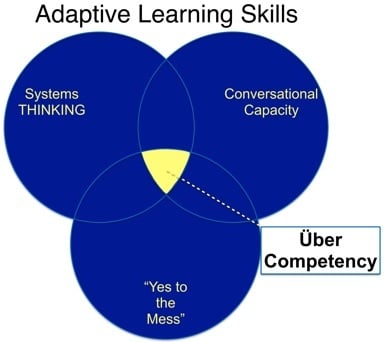
This session will introduce an integrated set of adaptive learning competencies that are essential for generating effective, collective, community impact. These competencies are: systems thinking, conversational capacity, and 'yes to the mess'.

Read More