


Semons la transformation
Un cadre bienveillant pour faire avancer l'équité, la réconciliation et l'appartenance
Ce que contient le guide « Semons la transformation : un cadre bienveillant pour faire avancer l’équité, la réconciliation et l’appartenance »
Vous y trouverez les informations et outils suivants :
-
Un aperçu du cadre de référence
-
Notre vision stratégique en matière d'équité, d'antiracisme et de réconciliation
-
Outil d'analyse de l'équité, de l'antiracisme et de la réconciliation
De plus, une variété d'outils développés à partir du Cadre de référence Semons la transformation peuvent être consultés ci-dessous:
-
Le jeu de carte sur l'équité (disponible uniquement en anglais pour le moment)
-
L'outil d'analyse de l'équité (disponible uniquement en anglais pour le moment)
-
L'outil sur les rôles nécessaires pour réaliser l'équité (disponible uniquement en anglais pour le moment)
-
L'outil sur les dimensions de l'amour (à venir)
-
L'outil de mobilisation des ressources pour l'équité (à venir)
-
Questions pour une responsabilité fondée sur l'amour (à venir)
-
L'outil de cadre de responsabilité collaborative (à venir)
Vous y trouverez également :
À propos du cadre de référence
Le guide « Semons la transformation » est une déclaration d’amour de Tamarack en réponse à notre engagement auprès de l’équipe, du conseil d’administration et du réseau de membres, d’apprenant.e.s et de partenaires de Tamarack. Ce cadre évolutif et ce plan d’action guideront notre cheminement vers l’équité, l’antiracisme et la réconciliation.
« À l'échelle mondiale, nous vivons une époque de profonds bouleversements. La planète est en crise. Nous sommes témoins des souffrances insoutenables des espèces, y compris l'espèce humaine. Nous en sommes en grande partie responsables. Il est possible que la planète retrouve un état de bien-être, mais cela exige un changement radical dans notre façon de penser. Cela nécessite de s’ouvrir à l'idée que les êtres humains se sont complètement trompés. » (Traduction libre)
Christi Belcourt - The Wisdom of the Universe
Si vous :
-
Êtes leader d’une d’équipe ou d’une organisation
-
Travaillez en entreprenariat avec une volonté de changer les choses pour améliorer le monde
-
Travaillez dans la fonction publique
-
Détenez une expertise dans l’élaboration de politiques ayant un impact sur le quotidien de nombreuses personnes
-
Luttez en première ligne pour la justice et l’équité
-
Agissez dans le développement communautaire souhaitant transformer les lieux de vie et de travail, ou simplement
-
Êtes une personne avec une expérience vécue confrontée aux défis du quotidien…
Le guide « Semons la transformation » est fait pour vous.
Pour un aperçu du contenu du guide avant de vous lancer dans la lecture, nous vous invitons à consulter notre rapport sommaire (disponible uniquement en anglais pour le moment), qui présente notre feuille de route pour les quatre prochaines années.
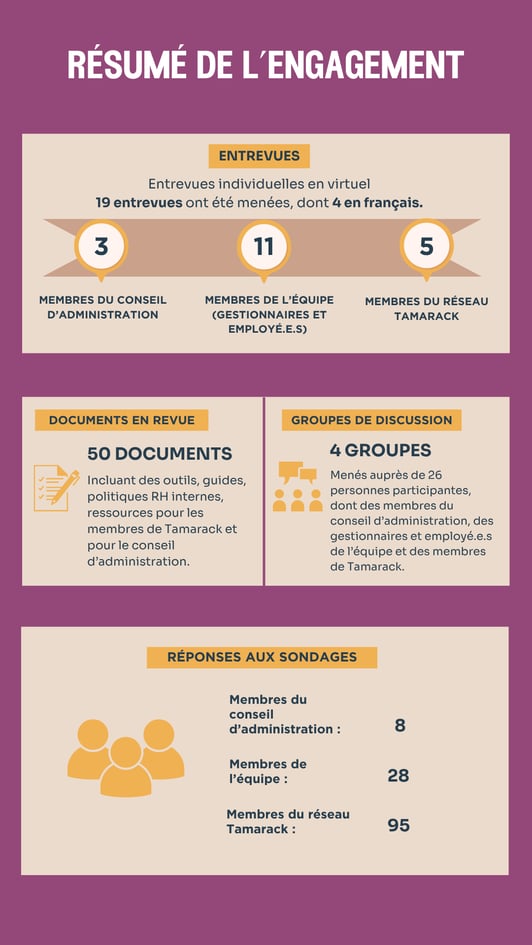
Notre vision stratégique pour l’équité, la lutte contre le racisme et la réconciliation
Nous avons défini sept priorités stratégiques qui proposent des plans d’action concrets, en lien avec le travail que l’équipe chez Tamarack, son conseil d’administration et son réseau de membres mettront en œuvre. Vous pouvez consulter nos priorités stratégiques à la page 3 du guide.
Mettre fin aux iniquités identifiées par la communauté
Notre objectif est d’aider les communautés à identifier et à démanteler les systèmes qui favorisent injustement certains groupes au détriment d’autres. Sachant que ces changements prennent du temps, nous agirons en soutien aux membres de Tamarack via le transfert de connaissances et l’accompagnement nécessaire pour que les membres puissent s’attaquer à au moins une iniquité au sein de leur communauté. Ce soutien tiendra compte du fait que les communautés se trouvent à différentes étapes de leur cheminement vers l’équité, la lutte contre le racisme et la réconciliation.
Soutien au bien-être de l’équipe de Tamarack et leur développement personnel et professionnel
Dans le cadre de nos efforts pour faire évoluer les politiques publiques et les systèmes à l’échelle communautaire, régionale et nationale, nous reconnaissons la nécessité d'une transformation interne. Nous nous engageons à recruter et à promouvoir des personnes issues de groupes sous-représentés et à co-créer une culture qui privilégie les personnes, les relations et la prise de décision partagée.
Établir des partenariats réciproques
Nous nous engageons à favoriser des relations authentiques et équitables avec les communautés les plus touchées par l’oppression. Cela implique de comprendre comment le contexte historique a injustement désavantagé certains groupes en raison de leurs identités croisées, dont l’âge, la langue, le genre, l’orientation sexuelle, l’origine ethnique, la « race » et/ou l’appartenance autochtone, ainsi que les parcours des personnes réfugiées, migrantes et nouvelles arrivantes et/ou les personnes vivant avec un handicap ou en situation de pauvreté. Tel que décrit à la priorité 1, cela comprend l’établissement de partenariats visant à lutter contre les inégalités systémiques, à promouvoir l’autodétermination et à instaurer une prise de décision respectueuse des diverses normes culturelles, visions du monde, histoires et droits des Premières Nations, Métis, Inuit et des communautés privées d’équité.
Mise en œuvre de mesures d'accessibilité
Notre objectif est d’éliminer les obstacles qui empêchent la pleine contribution et participation des personnes avec diverses habiletés. En faisant de l'accessibilité une priorité dans nos politiques internes, nos pratiques et nos espaces d’apprentissage, nous pouvons soutenir l'égalité des chances pour tous les membres et partenaires de Tamarack, ainsi que pour notre équipe et conseil d'administration.
Se servir des politiques publiques, des apprentissages et des plateformes de communication pour atteindre nos objectifs
Nous encouragerons des politiques qui priorisent l'équité, la lutte contre le racisme et la réconciliation, incluant une répartition équitable des ressources. Nous plaiderons en faveur de changements législatifs visant à corriger les inégalités systémiques et à promouvoir la justice et la réconciliation. Nous intégrerons une diversité de perspectives et d’histoires dans nos programmes, outils et publications. Nous mettrons en lumière les témoignages et les points de vue des communautés privées d’équité. Nous partagerons nos avancées et nos défis afin de renforcer la confiance et la transparence.
Favoriser des structures de gouvernance solidaires et inclusives
Notre conseil d'administration et nos membres apportent à Tamarack des perspectives, des expériences et des contributions diverses. Nous aspirons à créer des espaces de dialogue ouvert, de prise de décision partagée et d'action collective. En faisant évoluer notre structure de gouvernance, nous transformerons les rapports de force en constituant un conseil d'administration plus représentatif des communautés avec lesquelles nous travaillons, en réduisant les obstacles historiques à participer à la gouvernance et en partageant le pouvoir de décision avec les membres de Tamarack. Cela impliquera de comprendre l'expérience vécue des leaders et de prioriser leur bien-être et leur participation.
Promouvoir la transparence, l’imputabilité, la collaboration et la sécurité psychologique
Notre objectif est de créer un environnement où l'équipe de Tamarack, ses membres et partenaires peuvent contribuer, partager des idées et collaborer étroitement. Grâce à une communication transparente, des mécanismes de reddition de comptes clairs et un sens de respect mutuel, nous bâtissons la confiance et renforçons nos relations. En cultivant une culture de sécurité psychologique, nous favorisons la créativité, l'innovation et la résolution collective de problèmes.
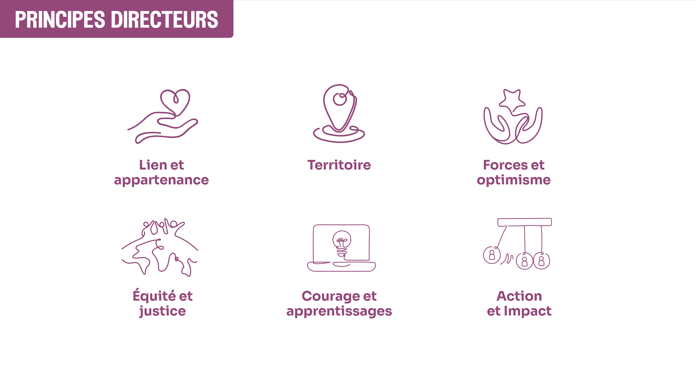
Ce processus nous a permis d’intégrer l’équité, la lutte contre le racisme, l’appartenance et la réconciliation aux principes directeurs de Tamarack. Cette intégration contribue à ancrer ces engagements dans l’ADN de notre organisation.
Vous pouvez approfondir ces principes à la page 9 du guide.
Avancer vers l'équité, l'antiracisme et la réconciliation
Dans le guide « Semons la transformation », nous proposons un processus itératif, continu et collaboratif – qui inclut la réflexion, le remaniement, l’engagement réciproque, la communication respectueuse et l’évaluation. Ce processus guidera nos actions et nous aidera à atteindre nos objectifs en matière d’équité, de lutte contre le racisme et de réconciliation.
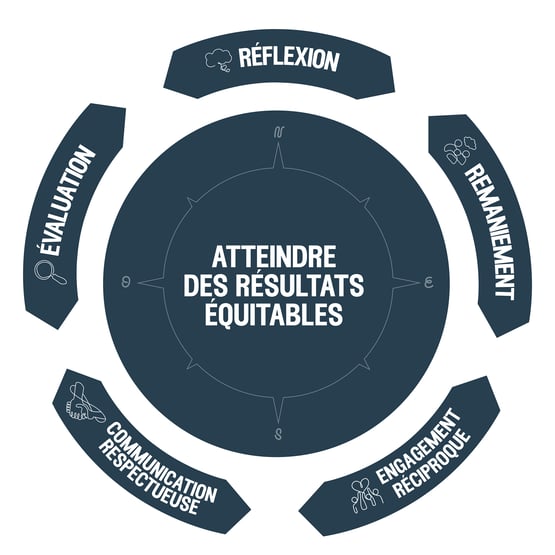
Vous pouvez explorer ce processus en détail à partir de la page 18. Vous pouvez aussi consulter le jeu de carte sur l'équité (en anglais uniquement pour l'instant) pour de conseils supplémentaires pour mettre en pratique cet outil dans votre contexte.
Outil d'analyse de l'équité, de l'antiracisme et de la réconciliation
.png?width=635&height=822&name=EAR%20Tool%20FR(1).png) Pour découvrir l'outil dans son intégralité, consultez la page 21 du guide. Consultez aussi l'outil d'analyse de l'équité (en anglais uniquement pour l'instant) pour un guide plus détaillé sur comment répondre à ces questions.
Pour découvrir l'outil dans son intégralité, consultez la page 21 du guide. Consultez aussi l'outil d'analyse de l'équité (en anglais uniquement pour l'instant) pour un guide plus détaillé sur comment répondre à ces questions.
Les rôles nécessaires pour réaliser ce plan
Nous avons également inclus un cadre décrivant comment nous allons mettre nos expériences uniques et évolutives au service du travail que nous nous sommes engagés à accomplir, présenté sous la forme des neuf rôles suivants. Ce cadre reconnaît que les rôles que nous jouerons varieront en fonction de nos forces, de nos connaissances et de nos expériences.
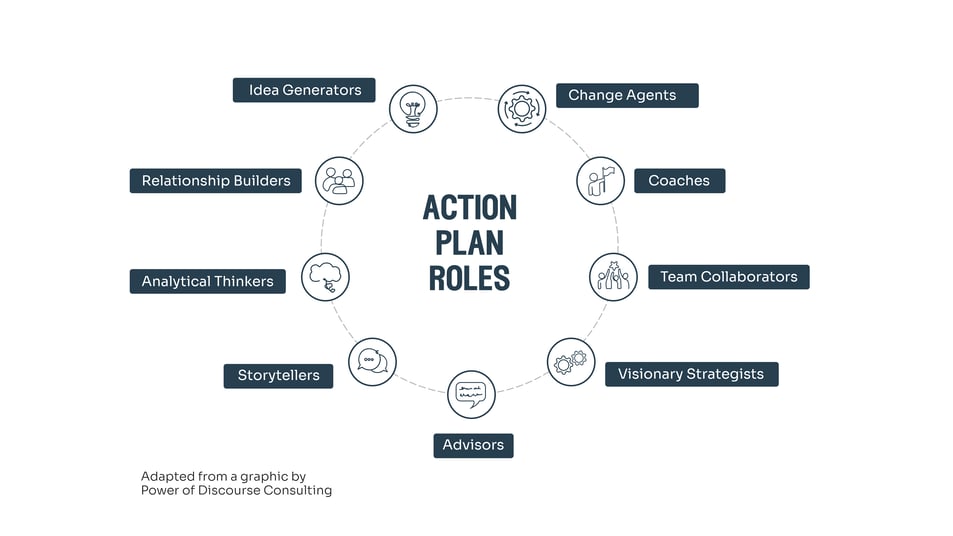
Pour explorer des questions réflexives liées à l'identification et à l'animation des rôles, voir la page 28 ou l'outil sur les rôles nécessaires pour réaliser l'équité (en anglais uniquement pour l'instant).
Notre cadre de responsabilisation DARCI
Nous utiliserons le cadre de responsabilisation DARCI (Personnes Décideuses, Imputables, Responsables, Consultées, Informées) pour élaborer des stratégies de mise en œuvre de notre plan d'action stratégique, qui figure sous chaque priorité stratégique aux pages 41 à 69.
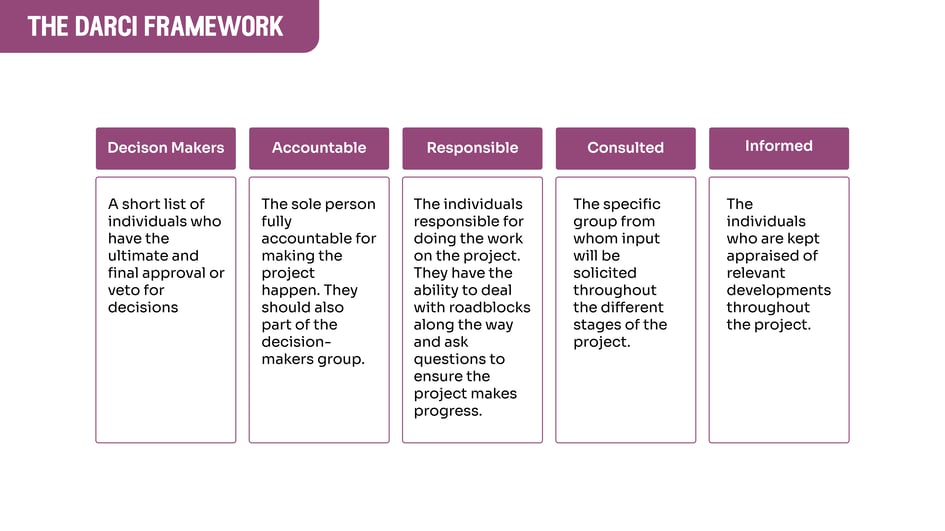
Une description du cadre se trouve dans l’annexe 2 à la page 80.
Notre cadre d'évaluation fondé sur l'amour
En concevant un cadre d'évaluation centré sur nos méthodes de travail, nous nous ouvrons à de nouvelles perspectives pour mesurer notre impact. Nous pouvons notamment dépasser les méthodes traditionnelles et adopter un cadre qui allie les approches eurocentrées, occidentales et décoloniales. Si vous souhaitez explorer de nouvelles façons d'évaluer votre travail, découvrez notre Cadre d'évaluation fondé sur l'amour à la page 34.
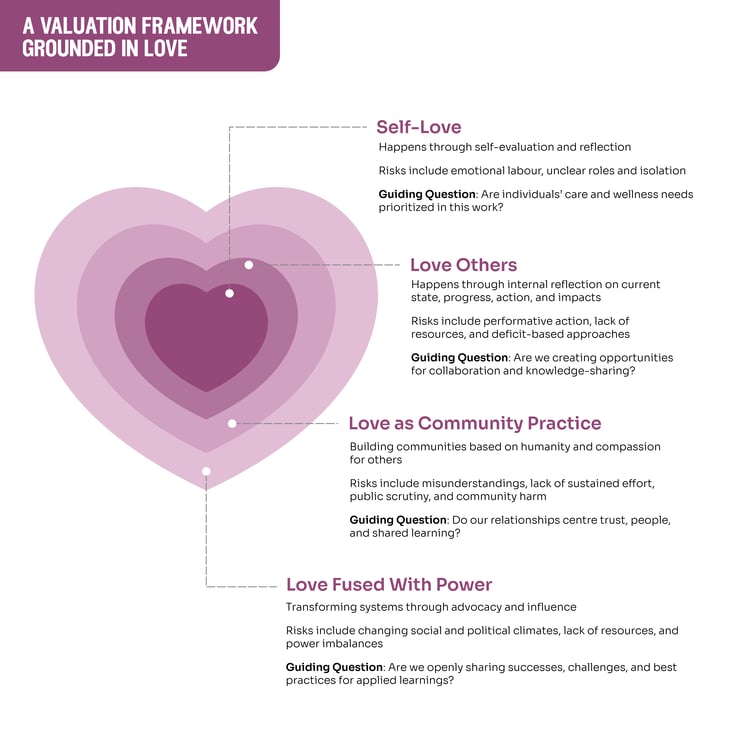
Le cadre d’évaluation fondé sur l’amour intègre les priorités et les perspectives suivantes, que vous pouvez explorer à la page 33:
-
Placer au centre les expériences vécues par les personnes concernées dans l’évolution de nos politiques et pratiques
-
Utiliser à la fois les données chiffrées et les récits
-
Privilégier les résultats aux actions
Terminologies clés

Par l’apprentissage et le dialogue, nous estimons que l’équité peut englober de nombreux aspects de la diversité, de l’inclusion, de l’antiracisme, de l’équité des genres et de l’inclusion des personnes 2ELGBTQI+, entre autres, sur notre chemin vers la justice. Nous reconnaissons également que la réconciliation est un processus unique visant à réparer les injustices historiques commises envers les peuples autochtones.
De même que notre engagement s’enracine dans le concept francophone de pérégrination – un parcours continu et transformateur d’adaptation et de croissance –, ce glossaire est un document évolutif que nous mettrons à jour au fur et à mesure que nous apprendrons quel langage nous permet de mieux mener à bien notre travail.
2ELGBTQI+
L'acronyme 2ELGBTQI+ représente les personnes bispirituelles, lesbiennes, gays, bisexuelles, transgenres, queers, intersexes, asexuelles et autres personnes qui s'identifient comme faisant partie de communautés de la diversité sexuelle et de la diversité de genre.
Le 2E en tête reconnaît les personnes aux deux esprits comme les premières communautés 2ELGBTQI+. Le I pour intersexe prend en compte les caractéristiques sexuelles au-delà de l'orientation sexuelle, de l'identité de genre et de l'expression de genre. Le + inclut les personnes qui s'identifient comme faisant partie de communautés de la diversité sexuelle et de la diversité de genre, ainsi que celles qui utilisent d'autres terminologies.
Il est aussi important de noter que le terme personnes aux deux esprits (2E) et personnes bispirituelles sont interchangeables, mais l'acronyme 2ELGBTQI+ reste le même.
Accessibilité
L'accessibilité est l'état d'être ouvert à une participation significative de toutes les personnes, en particulier celles dont la participation (à une activité spécifique ou à la société en général) est habituellement limitée par une forme d'oppression. L'accessibilité, de manière générale, signifie être exempt de barrières érigées, intentionnellement ou non, par le groupe le plus privilégié, comme le manque de services de garde d'enfants, de traduction ou de frais d'accès. Cela inclut également les barrières sociétales, telles que le logement considéré non comme un droit mais comme une marchandise. Parfois, le terme « accessibilité » est utilisé en référence spécifique aux besoins des personnes handicapées. Un espace ne peut être considéré comme « accessible » en ce sens si l'atmosphère y est validiste, même si des mesures telles que des lieux accessibles aux fauteuils roulants, des ressources en braille/gros caractères/enregistrements audio, un service de télécommunication pour sourds (ATS) et l'interprétation en langue des signes sont mises en place. Il est recommandé d'intégrer l'accessibilité dès la planification et la conception, car cela permet à tout le monde d'y accéder.
Source : Anti-racist Toolkit, "Anti-Oppression Glossary,” Fédération canadienne des étudiant.e.s.
Allié.e.s/Complices
Être allié.e/complice signifie que des personnes issues de groupes privilégiés œuvrent en solidarité avec les communautés marginalisées, en utilisant leur pouvoir pour lutter contre les inégalités systémiques qui perpétuent des problèmes tels que la pauvreté ou le sentiment d’exclusion. Cela implique non seulement de reconnaître ses privilèges, mais aussi de prendre des mesures concrètes pour amplifier les voix des personnes marginalisées, promouvoir des politiques équitables et lever les obstacles à leur participation aux initiatives communautaires. Par exemple, un leader communautaire qui cherche à activement soutenir le leadership des personnes noires, autochtones et de couleur (PANDC) dans les initiatives de lutte contre le changement climatique fait preuve d’engagement solidaire en favorisant la diversité et l’inclusion dans la lutte contre l’injustice environnementale.
Source : Anti-racist Toolkit, "Anti-Oppression Glossary,” Fédération canadienne des étudiant.e.s.
Anti-oppression
La lutte contre l'oppression ou l'anti-oppression consiste à identifier et à remettre en question les systèmes et les comportements qui perpétuent les inégalités et la marginalisation. Elle s'attaque non seulement aux discriminations individuelles, mais aussi aux structures plus larges qui privilégient les groupes au pouvoir tout en marginalisant les autres en raison de leur race, de leur genre, de leur handicap ou d'autres identités. La lutte contre l'oppression vise à redistribuer le pouvoir afin de créer des environnements inclusifs où toutes les voix sont valorisées et où chaque personne peut participer pleinement. Elle met également l'accent sur l'intersectionnalité, reconnaissant comment les différentes formes d'oppression s'entrecroisent et se renforcent mutuellement, ce qui exige des solutions globales pour un changement systémique et durable.
Anti-racisme
L’antiracisme est un processus actif qui consiste à identifier et à démanteler les comportements et les systèmes racistes qui perpétuent les inégalités. Il donne la parole aux personnes noires, autochtones et racisées, redistribue le pouvoir et favorise des espaces inclusifs où les diverses communautés peuvent s’épanouir. Fondé sur l’équité, l’antiracisme implique une responsabilité collective et s’attaque au racisme systémique afin de bâtir une société juste.
Appartenance
L'appartenance est le besoin humain d'être connu et remarqué au sein d'une communauté. Ce besoin est profondément ancré dans un lieu. Les communautés qui cultivent un fort sentiment d'appartenance disposent d'une infrastructure sociale saine qui favorise la cohésion et le bien-être social et renforce la vie civique.
Autochtone
Indigenous refers to the original peoples of any given land who have been adversely impacted by colonization, imperialism and capitalism through the displacement and settlement of their traditional territories. In Canada, the Indigenous peoples of this land are Aboriginal people which includes First Nations, Métis, and Inuit peoples.
Source: Anti-racist Toolkit, "Anti-Oppression Glossary,” Canadian Federation of Students.
Autochtonisation
Indigenization is the deliberate integration of Indigenous knowledges, values, and practices into institutions and policies, ensuring they reflect Indigenous worldviews. This process involves collaboration with Indigenous communities to embed their perspectives in decision-making and leadership. It also encompasses reconciliation by acknowledging settler colonialism and decolonization by dismantling colonial views.
By prioritizing relationships with Indigenous leaders, Indigenization aims to address systemic inequalities, foster belonging, and support community-driven solutions, contributing to more equitable, peaceful, and sustainable societies. While Indigenization is connected to decolonization and reconciliation, each are distinct in their goals and approaches. Though different, all three frameworks are equally important in fostering equity and justice for First Nations, Métis, and Inuit Peoples.
Biais
Un biais est une opinion, une préférence ou un préjugé formé sans justification raisonnable. Il influence la façon dont un individu ou un groupe perçoit et juge objectivement et précisément une situation, et peut engendrer une préférence pour ou contre. Par exemple, préférer travailler avec un groupe en particulier plutôt qu'avec un autre groupe avec lequel on n'a aucune expérience est un biais.
Source : Anti-racist Toolkit, "Anti-Oppression Glossary,” Fédération canadienne des étudiant.e.s.
Colon
In the context of Indigenous discourse in Canada, the term "settler" refers to non-Indigenous people who live on lands traditionally and continually occupied by First Nations, Métis, and/or Inuit Peoples. This designation encompasses people who have arrived at various points in history, including contemporary times. It refers to any non-Indigenous people whose presence contributes to the ongoing dynamics of settler colonialism, a structure characterized by the displacement and attempted assimilation of Indigenous communities. The term underscores the responsibility of non-Indigenous individuals to acknowledge and address the historical and present-day impacts of colonization on Indigenous Peoples
Compensation communautaire
Community compensation refers to the equitable remuneration of community members for their time, expertise, and lived experiences when engaging with organizations, particularly in grassroots and non-profit sectors. It ensures that individuals, especially those historically excluded, are fairly compensated for their contributions to decision-making, advisory roles, or project participation. This practice values community input, promotes equity, and fosters stronger partnerships by addressing systemic inequities and recognizing the importance of lived experience in shaping meaningful outcomes
Diversité
Diversity refers to the variety of differences that exist between individuals and groups. It includes many different dimensions of identity, including but not limited to race, ethnicity, gender, sexual orientation, age, religion, socioeconomic status, physical and mental abilities, and cultural background. Our diverse identities impact how we experience advantages or encounter barriers such as belonging, access to resources and poverty.1
Equité
Equity recognizes that people have different needs and that treating everyone the same may not lead to fair outcomes. It depends on addressing systemic barriers and structural inequalities that disproportionately affect marginalized communities. Equity involves giving everyone what they need to be successful, even if that means giving some people more resources or opportunities than others. Equity leads to equality of opportunities.1
Tamarack offers the Be A Light Fund scholarship as one of our equity measures. An equal approach would be to charge everyone the same rate regardless of circumstances. An equitable approach offers discounted rates for individuals with financial barriers. The scholarship creates more equal opportunities for learners wishing to access events and workshops.2
Fondé sur des distinctions
A distinctions-based approach refers to policies and practices that recognize and respect the unique rights, interests, and circumstances of the three distinct Indigenous groups: First Nations, Métis, and Inuit. This approach acknowledges that each group possesses its own cultures, histories, rights, laws, and governance structures, necessitating tailored strategies to address their specific needs and priorities
Genre vs. Sexe
Sex is designated at birth based on reproductive organs and chromosomes, which creates a binary of male and female. For many people, their sex matches their gender identity, though these should be considered separate. Trans people, for example, are assigned one sex at birth but have a different gender identity. Gender, on the other hand, denotes a social, cultural, or psychological state of being, as opposed to that of biologically assigned sex. Some people do not have a gender identity that corresponds to their assigned sex, namely transgender, transsexual, intersex, and genderqueer individuals.
Source: "Anti-racist Toolkit, Anti-Oppression Glossary,” Canadian Federation of Students.
Groupe en quête d'équité
To be an equity-denied person/group means to be excluded, ignored, or pushed to the outer edge of a group, society, or community. Equity-denied groups have historically been denied equal access to opportunities such as employment, education, social services, and access to housing.
Inclusion
Inclusion is the practice of creating a welcoming and supportive environment where everyone feels valued, feels respected, and has a sense of belonging, regardless of their background, identity, or abilities. Inclusion involves actively seeking out and valuing diverse perspectives, experiences, and identities and creating spaces where everyone can participate and contribute fully without fear of judgment or repercussions.1
Inuit
Inuit people are the Aboriginal people of Arctic Canada, who live above the tree line in the Northwest Territories, Nunavut and in Northern Quebec and Labrador. However, large communities of Inuit can be found in Ottawa, Ontario and Edmonton, Alberta. The Indian Act does not cover the Inuit; however, in 1939, the Supreme Court of Canada interpreted the federal government’s power to make laws affecting “Indians, and Lands reserved for the Indians” as extending to the Inuit.
Source: Anti-racist Toolkit, "Anti-Oppression Glossary,” Canadian Federation of Students.
Justice
Justice is an evolving concept of fairness and the idea that individuals must be treated equitably, have equal access to opportunities and resources, and have a right to self-determination. Justice systems are based on principles of morality, ethics, and law, but allow systems that perpetuate inequity to be challenged to dismantle present-day systemic inequalities.
At its core, justice is about maintaining good relationships through using the resources at our disposal to ensure people are treated in ways that they feel create a culture of dignity, respect and trust to preserve the health and well-being of individuals and the community.1
Mené par des colons
A settler-led organization is one where the leadership and decision-making roles are primarily occupied by non-Indigenous individuals. Even when such organizations employ First Nations, Métis, and Inuit staff, the organization can still be described as settler-led if management positions continue to be predominantly held by non-Indigenous individuals. This dynamic reflects broader patterns of settler colonialism, where non-Indigenous governance structures often oversee initiatives affecting Indigenous communities.
Métis
Métis refers to Aboriginal people of specific mixes of First Nation and European ancestry who identify as Métis people, distinct from First Nations, Inuit, or non-Aboriginal people. The Métis have a unique culture that draws on their diverse ancestral origins, such as Scottish, French, Ojibway, and Cree.
Source: Anti-racist Toolkit, "Anti-Oppression Glossary,” Canadian Federation of Students.
Obstacle
Dans les approches axées sur l'équité, un obstacle, qu'il soit manifeste ou latent, désigne une entrave systémique à l'égalité des chances ou des résultats. Pour parvenir à l'égalité, il est indispensable de lever ces obstacles. Ces derniers engendrent des inégalités entre les communautés et au sein même de celles-ci. Par exemple, vivre en milieu rural ou isolé constitue un frein important à l'accès à l'éducation, à l'emploi et à bénéficier des solutions face aux changements climatiques.
Source : Anti-racist Toolkit, "Anti-Oppression Glossary,” Fédération canadienne des étudiant.e.s.
Oppresseur, Opprimé, Oppression
An oppressor is either one who uses their power to control a group or individual, or one who refuses to use their power to stop abuses of power.
An oppressed person, or equity-deserving person, is controlled by an oppressor and by those who remain silent in the face of oppression occurring.
Oppression is the state of being subjected to unjust treatment or control. There are many forms of intersectional oppression, including racism, sexism, classism, heterosexism, anti-Semitism, Islamophobia, ableism, ageism, homophobia, and transphobia.
Source: "Anti-racist Toolkit, Anti-Oppression Glossary,” Canadian Federation of Students.
Orientation sexuelle
Sexual orientation is about who someone feels romantic or sexual attraction toward. A person might be attracted to people of a different gender, the same gender, more than one gender, or not feel sexual attraction at all. Everyone's experience of sexual orientation is different, and it can change over time.
Pérégrination
The French word pérégrination refers to a journey, often into an unknown or foreign place, where a person goes in search of new or expanded meaning about themselves, others, nature, or a higher good through the experience. It can lead to a personal transformation, after which the pilgrim returns to their daily life.
While the process and outcomes needed may shift in response to staff, community, and societal needs, our foundational goal to achieve equitable outcomes in the community will not.
Tamarack’s journey including the process, learning and action is just as important as achieving equitable outcomes across communities.
Postionnement social
A person’s relative position within society based on how closely their various social identities align with societal norms and ideals. It impacts how they are generally perceived by others, their relative access to resources, social acceptance, respectability, representation and visibility, authority, and their overall experiences in the world. Your social location is influenced by the privilege and power you have.
Source: Terms and Definitions: Systems of Oppression and Privilege,” Egale, https://egale.ca/awareness/systems-of-oppression-and-privilege-terms/
Pouvoir
Power is a relational concept that can involve control over access to valued resources. It can manifest visibly, hidden, or invisibly, and can also embody positive attributes through community empowerment and collective action.
It encompasses power over others, power with others, and power within a group, and can be held by both individuals and groups.
Power can be acquired at the expense of others and wielded for both positive and negative purposes. Traditionally seen as domination, power also serves as a positive force for change.
-
Power over relates to domination and control, often perpetuating inequality.
-
Conversely, power with builds collective strength and equitable relations.
-
Power to highlights individual potential for action.
-
Power within focuses on self-worth and mutual respect.
Power can be personal (values, beliefs, feelings), interpersonal (actions, behaviours, language), institutional (rules, policies, procedures), and cultural (concepts of beauty, truth, right).
Premières Nations
While “First Nations” refers to the ethnicity of First Nations peoples, the singular “First Nation” can refer to a band, a reserve-based community, or a larger tribal grouping and the status Indians who live in them. For example, the Stó:lō Nation (which consists of several bands), or the Tsleil-Waututh Nation (formerly the Burrard Band).
Source: Anti-racist Toolkit, "Anti-Oppression Glossary,” Canadian Federation of Students.
Privé d'équité
Equity-denied groups are communities that experience ongoing systemic barriers to full inclusion and participation as a result of entrenched histories of discrimination and exclusion. These barriers limit fair access to opportunities, resources, and decision-making power and are shaped by intersecting factors such as race, Indigeneity, gender identity, sexual orientation, socioeconomic status, disability, age, and religion. In the Canadian context, equity-denied groups often include Indigenous Peoples, racialized communities, 2SLGBTQI+ individuals, women, people with disabilities, and religious minorities. Addressing inequity requires recognizing that these barriers are created and maintained by institutional systems, not by the individuals or communities experiencing marginalization, and that it is the responsibility of those systems to create pathways for equity, belonging, and justice
Race
The idea that the human species is divided into distinct groups based on inherited physical differences. Genetic studies in the late 20th century refuted the existence of biogenetically distinct races, and scholars now argue that “races” are cultural interventions reflecting specific attitudes and beliefs that were imposed on different populations in the wake of Western European conquests beginning in the 15th century. The idea of race as a socially constructed way of grouping people is important because of the way that “the ideology of race has become embedded in our identities, institutions, and culture... as the basis for discrimination and domination.”
Source: Britannica. United Way Worldwide, "Strengthening Our Equity Muscle to Accelerate Impact, The United Way Equity Framework” Appendix D, Glossary of Terms, page 129.
Racisé.e
Racialized refers to anyone who experiences racism because of their race, skin colour, ethnic background, accent, or culture. Racialized people are people of colour, Indigenous peoples and ethnic and cultural minorities.
Source: "Anti-racist Toolkit, Anti-Oppression Glossary,” Canadian Federation of Students.
Réconciliation
In a Canadian context, Reconciliation refers to the process of acknowledging and addressing the harms and injustices inflicted upon First Nation, Métis, and Inuit Peoples, particularly in the context of colonialism and its ongoing legacy. It involves working towards a respectful and equitable relationship between Indigenous and non-Indigenous peoples based on mutual understanding, healing, and recognition of First Nation, Métis, and Inuit rights and sovereignty. This may look like having a comprehensive community compensation guide or process for community engagement.5
Résultats équitables
Equitable outcomes reference situations where there is no variation in outcomes at a population level based on race or ethnicity. Equitable outcomes require that power is shared with those most impacted by current systems and that we transform our individual, organizational, and collective societal behaviours to centre work that narrows and ultimately eliminates disparity gaps.
Sécurité psychologique
In the context of work, psychological safety is a condition where the environment supports team members' well-being and actions are collectively taken to reduce both potential and actual harm to their mental well-being. Team members share the responsibility of fostering this safety by contributing to a culture of trust and respectful dialogue, where everyone feels invited to express and develop solutions for concerns and participate in maintaining a safe and supportive workplace.4
Systèmes d'oppression
Systems of oppression refer to how societies or groups of people create and maintain unfair power dynamics that disadvantage certain individuals or communities based on characteristics like race, gender, class, sexuality, or ability. These systems can include laws, policies, social norms, and economic structures that perpetuate inequality and limit opportunities for marginalized groups
Tokénisme
Tokenism means including people from underrepresented groups to demonstrate diversity, but does not truly value or include diverse perspectives and experiences. This often happens in institutions and organizations and doesn't address systemic discrimination. In the anti-racist view, tokenism is seen as a surface-level attempt to show diversity by highlighting a few individuals without addressing the real problems of fairness and justice. Examples of tokenism include having diverse representation but not listening to their voices.
Source: "Anti-racist Toolkit, Anti-Oppression Glossary,” Canadian Federation of Students.
Transformation des rapports de pouvoir
Power transformation is the notion of giving historically excluded communities direct control over shaping their own experiences and sense of belonging. Power transformation recognizes the nuances of power by creating a shared agreement that creates self-determination for historically excluded communities to direct the shift of power in sustainable and realistic phases.
Vision du monde
Ressources d’apprentissage
Dans le cadre de notre pérégrination — notre parcours d'apprentissage continu — nous proposons des opportunités et des outils pratiques pour soutenir votre apprentissage.
- Lignes directrices concernant les journées marquantes (disponible en anglais seulement) - Au sein de votre organisation ou de votre communauté, tout comme chez Tamarack, de nombreuses personnes célèbrent diverses dates d’importance ethnoculturelle, religieuse ou spirituelle à l’échelle mondiale. C’est pourquoi Tamarack a élaboré un guide ainsi que des pages de ressources pour soutenir vos efforts visant à bâtir des communautés inclusives où chaque personne se sent à sa place et où les voix du monde entier sont honorées. Ces ressources sont évolutives et ne se veulent en aucun cas exhaustives ; elles constituent un point de départ dans votre démarche de création de communautés inclusives favorisant un sentiment d’appartenance.
-
Ressources pour le Mois du patrimoine des Asiatiques et des habitants des îles du Pacifique (disponible en anglais seulement)
-
Ressources pour la vérité et la réconciliation (disponible en anglais seulement)
Obtenez du soutien
Nous vous accompagnerons pour que vous abordiez votre démarche avec intention et responsabilité, tout en bâtissant des bases solides d'apprentissage et de désapprentissage.
Restez à l'affût
Inscrivez votre adresse courriel et choisissez vos abonnements.