
Tamarack's
2025 Annual Report
What We Learned in 2025
Acknowlegdements
In the spirit of respect, reciprocity, and truth, we honour and recognize that our work occurs across Turtle Island (North America) and around the world. We do this in acknowledgment of the legacies of colonialization, slavery, and racism and with accountability so that our work for community change promotes more equitable futures for all.
Land Acknowledgements
We recognize that most of our work occurs on the ancestral homelands of Indigenous Peoples, including First Nations, Métis, and Inuit Peoples. We recognize the contributions of Indigenous people and support their ongoing struggle for self-determination and sovereignty. We work to understand the history of the lands upon which we are guests and to contribute to justice for all Indigenous Peoples.
African Ancestral Acknowledgement
We also wish to acknowledge those who came to Turtle Island – as migrants either in this generation or in generations past – and those of us who came here involuntarily, particularly those brought to these lands as a result of the Trans-Atlantic Slave Trade and Slavery. Tamarack pays tribute to those ancestors of African origin and descent and thanks them for their contributions toward transforming systems in ways that promote everyone’s sense of belonging and safety. At Tamarack, we are taking action that allows us to be aware of, recognize, and address the systemic ways in which anti-Black racism manifests.
Black and Indigenous communities demonstrate that we can work together in solidarity toward peace and equity as we use collective wisdom, knowledge, and gifts that promote healing within our communities.
Reconciliation Commitment
We recognize that, across this land, Indigenous rights holders continue to endure systematic oppression and inequities that have resulted from widespread colonialist systems and ideologies. Recognizing the importance of First Nations, Métis, and Inuit perspectives, knowledges, and sovereignty, we commit to building intention, respect, reciprocity, collaboration, and cultural humility into the relationships we hold with First Nations, Métis, and Inuit rights holders.
We seek to create opportunities for shared learning, co-creation, and collective action that honour First Nations, Métis, and Inuit values, traditions, and aspirations and that honour reconciliation. Through our commitment to reconciliation, we will also incorporate Indigenization and decolonization frameworks into our work. While connected, each are distinct in their goals and approaches, and each are equally important in fostering equity and justice for Indigenous Peoples. In recognition of Tamarack’s position as guests on the ancestral homelands of Indigenous Peoples, we commit that work related to reconciliation will be led by individuals who self-identify as First Nations, Métis, and Inuit, seeking external support where internal team member capability is limited.

A Letter from the Tamarack Board of Directors.
From a Board perspective, meaningful systemic change is driven by strong organizing, shared leadership, and a deep understanding of community and institutional dynamics. It is through the lived experiences, relationships, and leadership of people that priorities are grounded and solutions take shape. It is through collective leadership and coordinated effort that momentum is sustained, and the status quo is effectively challenged. And it is through a clear understanding of place that this work remains responsive to the unique strengths, histories, and realities of the communities we serve.
Sustained progress also depends on having the resources and conditions necessary to support this work over time. While passion can spark and energize action, it is the alignment of people, strategy, and resources that enables change to endure. This is reflected in our partners’ commitment to staying engaged, adapting, learning and unlearning, and continuing to advance equitable outcomes even when progress is complex or incremental. This enduring drive is what makes the Tamarack Board unique and helps move efforts beyond isolated initiatives toward coordinated, systemic solutions that create lasting impact.
Ana Gonzalez Guerrero captured it well in our Spring Tamarack board meeting, when we affirmed our commitment to a framework and actions that centre equity, anti-racism, and reconciliation.
“Changing systems in this moment requires doubling down. And doubling down will provide reassurance and strength to others looking to do the same.”
We are committed to transparent and effective governance, recognizing it as the stabilizer that enables strong, consistent, and accountable operations. This year, we rewrote our bylaws to clarify how decision-making is distributed across the network, expand the composition of our committees, and formalize leadership roles. We also supported an open call for Board members, strengthening transparency and accessibility, and updated key policies on gift acceptance and financial investments to better align with our values and long-term sustainability.
In 2025, we provided a platform for social purpose organizations to share their vision for powerful partnerships with philanthropy. This is critical and timely, as it helps shift traditional power dynamics, ensuring that those closest to the work have a stronger voice in shaping funding priorities and partnership approaches. By centring these perspectives, we foster more equitable, responsive, and impactful collaborations with diverse people - where resources are aligned with real community needs, and solutions are co-developed rather than imposed.
This year marks a period of significant change for the Board. We are grateful for the generosity of both incoming and outgoing members, who have given their time, shared their expertise, and led with care. Their contributions have strengthened our governance, balancing fresh perspectives with continuity in our values and direction, and helping to steer the organization through a complex and changing landscape.
We are deeply grateful to our departing Board colleagues - Sunshine Chen, Ana Gonzalez Guerrero, Lori Hewson, Precious Ile, and Mary Pickering - for the tenacity, experience, and care they brought, and the community they nurtured. Like so many community changemakers, they poured themselves into the quiet, daily work that makes collective efforts possible. Thank you for your dedication and leadership.
To our incoming board members – Louise Adongo, Scott Graham, Anna Hardie, Hisham Abu-Abdel, Marwa Suraj, and Krystal Renschler - welcome! You join at an energizing moment in our work - strengthening partnerships across philanthropy, national networks, and international coalitions working to localize and scale our shared impact. Most importantly, you join alongside local communities who are acting with clarity and determination to advance the future they envision.
And to the tens of thousands of you who shape and define who and what Tamarack is, you embody the power of people, the grounding of place, and the enduring momentum of passion. You are the reason for our joy and inspiration - thank you for being part of this journey and for the collective impact we create together.
With appreciation and resolve,
Nation Cheong, Outgoing Board Chair / Chair Emeritus
Colleen Cote-Christopherson, Incoming Board Chair
Place-based change has never mattered more.
During the late-2025 Tamarack staff quarterly team retreat, we reaffirmed our commitment to ending poverty in all its forms. While our context and approaches have shifted since we set this intention in 2020, our commitment to the goal is unwavering.
In 2025, a framework grounded in love anchored our contributions to systems change. We asked: How do we show ourselves love? How, in nurturing collaboration, do we show our love for others? How are our collaborations prioritizing trust, learning, and community-driven impacts? How are we fusing love and power in ways that shift policies, narratives, and other systems?
We amplified community experience, learning, and aspirations, in order to scale impact, discern questions and priorities, and mobilize individuals ready to work through them.
We supported the growing number of communities and changemakers grappling with how to end poverty in its many forms – economic, environmental, intergenerational, and relational. We celebrated the growing number of partners (including the World Economic Forum, National Advisory Council on Poverty, the Public Health Agency of Canada, and the Government of Manitoba) who centred the idea that lasting change begins in communities, with those who most acutely experience what’s not working, and with networks that bring communities together.
The stories ahead highlight how communities and changemakers sought, sparked and celebrated local wisdom, strengths, and dreams of communities in 2025. They elevate how communities modelled collaboration across sectors and scales in the service of meaningful change. They also reflect on the three priorities that shape Tamarack’s contributions to ending poverty in all of its forms
-
Helping people build connections and support each other in new ways of thinking and working
-
Catalyzing places to coordinate their numerous programs, strategies, and other assets toward big change, and
-
Nurturing movements that bring together networks of places to shift policies, offer new narratives, and build collective power.
And we celebrated you. In tumultuous times, you moved us into Tamarack’s next era – one unshakeable in its commitment to ending poverty in its many forms. And one where we live that commitment through the power of collaboration and community, centring equity, anti‑racism, and reconciliation with specificity and visibility.
Everyone has gifts to contribute to building equitable outcomes for communities. Community is a verb. We are thrilled to be in action with you.
Tamarack’s 2025 alignment team: Danya Pastuszek (she/her), Bobby MacPherson (they/them), Jana Harris (she/her), Jorge Garza (he/him/il), Justin Williams (he/him), Lisa Attygalle (she/her), Rochelle Ignacio (she/her), and Ruté Ojigbo (she/her).
About Tamarack Institute
Tamarack exists to end poverty in all its forms. Economic poverty. Social poverty. The poverty of education inequity. The poverty of our relationships with our planet and other living things.
We convene and build the capacity of 40,000+ changemakers every year through webinars, workshops, courses, cohorts, and 1-on-1 coaching. We work alongside over 150 cities, regions, and First Nations in rural and remote areas, and small cities. We recognize communities as key to solving most complex social problems, and we bring local communities together to shape public policy and narrative.
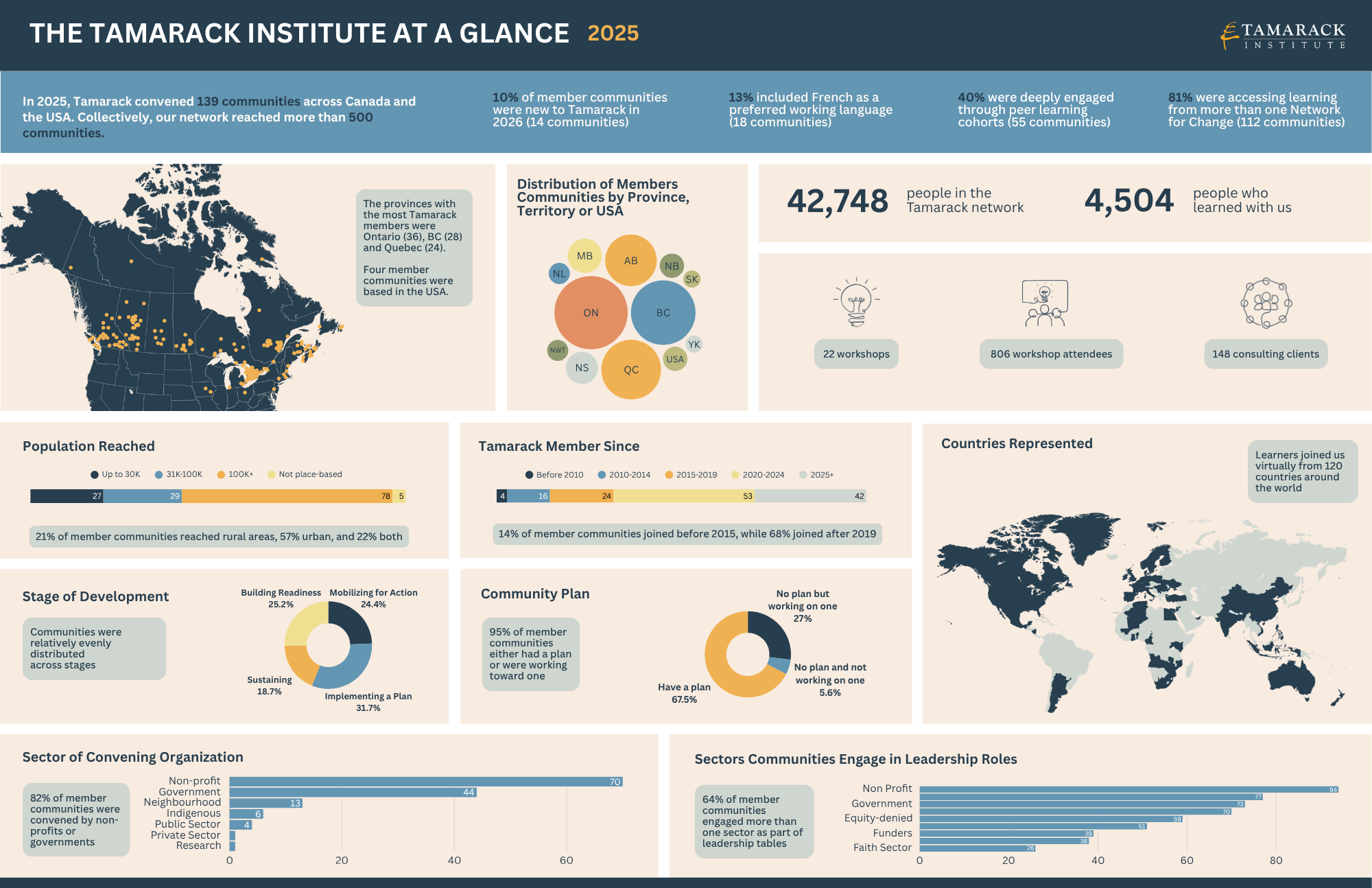
What We Learned
In 2025 – halfway through the decade of action and Tamarack’s 2030 strategic plan – our work alongside communities deepened our understanding that:
Belonging is the foundation upon which thriving communities are built. It is core to our civic life; when we feel connected to our communities, we’re more likely to contribute positively to their futures. Belonging is the foundation of democracy. Achieving conditions that nurture belonging requires putting diverse lived experiences at the centre of decision-making and developing approaches that are community-led, equity-focused, and informed by local context and data. To ensure lasting change, belonging must be embedded within policy, practice, and systems through approaches like a Canada-wide Belonging Strategy. Tamarack's 2025 From Dialogue to Action: The Strategy for Belonging Midpoint Report highlights more on how communities are boldly advancing belonging.
Relationships are the engine of change. Our work with local communities reaffirmed that how we do our work matters. We saw consistently how relationships - both within and between communities - are not a “soft” byproduct of collaboration, but the foundation of how we move from awareness of an issue into action. We witnessed profound and systemic shifts as communities moved toward reciprocity. In Yellowknife, the Yellowknife Youth Network transformed its leadership structures to centre a collective agency, proving that youth engagement is most impactful when rooted in mutual accountability. In London, we saw climate resilience built as partners work one conversation at a time to centre lived experience and move beyond planning to implement strategies that truly reflect local needs. These communities remind us that the strength of our connections is a form of systems change; systemic change grows through trust, not just transactions.
We can’t achieve our goals without centring equity. In 2025, after a two-year consultation and design process, we named our commitments to equity, anti-racism, reconciliation, and belonging in Seeds of Transformation: A Loving Framework for Equity, Reconciliation and Belonging. We took steps in seven areas focused on culture, governance, policy, relationships, and decision‑making in the service of ending equity disparities in communities. We focused on expanding our understanding of anti‑racism and reconciliation, testing an equity analysis tool, and launching a decision-making framework.
Ending working poverty will strengthen every aspect of well-being. Nearly half of the people who live in poverty in Canada work; of this group, a third hold full-time, full-year jobs. Working poverty is pervasive and strains people, families, communities, economies, and our collective well-being. Seeing this, Tamarack, alongside communities in Chatham-Kent, Drumheller, Saskatoon, Trail and Winnipeg, undertook a three-year project to create and begin implementation of ending working poverty strategies. We worked with the Open Policy Institute to understand the local labour markets, service gaps, and access to amenities in each place. We shared the process, learnings, early impacts, and roles that each of us can plan in the Ending Working Poverty Roadmap and Toolkit. The patterns that emerged informed insights about how financial capital flows and narratives must shift - and became the basis for community-driven public policy priorities related to financial inclusion, basic income, income support and belonging.
Financial capital is critical to the transformations we need. In 2025, we supported local communities to diversify revenue sources, and we explored what it would take to access and influence new types of financial capital. Through the Learning Centre, we partnered with a dozen funders in moving toward more participatory granting practices, building community engagement frameworks, and exploring capacity to fund collaborative efforts. We brought non-profits, charities, funders, and others into a shared message about the role of collaborative, honest, and purpose-driven relationships between funders and organizations in achieving community-driven results. We grounded in the multiple roles that those who direct financial capital have in the work of community change.
Stories of Action and Impact.
The stories below are but a few examples of communities that have moved from intention to action. Collectively, these stories show the application of lessons into practice and the moment we are in, and the opportunity we have to further invest in place-based collaboration and leadership.
Catalyzing Collective Well-being: A Multi-Level Approach to Systems Change
Ending poverty and social fragmentation requires more than isolated interventions; it requires a multi-layered approach that bridges People, Places, and Policy. Two specific milestones from this past year demonstrate the magnitude of what we can achieve when we weave these layers together: Our collaborative work with the Public Health Agency of Canada’s Intersectoral Action Fund (ISAF) and our deep engagement with the Tri-Cities Intergenerational Belonging Project. While these projects address different dimensions of poverty, both build the relational infrastructure required for a society where everyone can thrive. Through the ISAF, we witnessed how amplifying the wisdom of cross-sector leaders can reshape public health to be more equitable and community-led. Simultaneously, our journey with the Tri-Cities team proved that the relational infrastructure of a community, the bonds between generations, is the strongest defense against loneliness and inequity. We continue to do this work because we believe that real change only becomes inevitable when local innovation is connected to systems-wide shifts.
Advancing Equity Through Trust-Based, Participatory Grant Making in the Region of Waterloo
The Region of Waterloo demonstrated the transformative power of institutional courage by stewarding a trust-based, participatory grantmaking model that places equity-denied communities at the forefront of decision-making. As an active Tamarack member, the Region adopted practices and tools designed to shift power directly to community partners and beneficiaries, specifically First Nations, Inuit, and Métis, African, Caribbean, and Black, and racialized communities. Leveraging its Community Safety and Wellbeing Plan through this participatory approach, the Region directed $2.89M in funding, contributing to nearly $15M invested in local needs such as housing supports, culturally relevant services, mental health programming, and initiatives that strengthened connection and well-being. By reducing application barriers and allowing community members to join grantmaking panels, the Region has deepened cross-sector partnerships and demonstrated what can happen when trust and relationships are prioritized over transactional investments.
20 Years of Impact: How Calgary and Hamilton Shifted Systems and Reduced Poverty
For two decades, Vibrant Communities Calgary and the Hamilton Roundtable for Poverty Reduction have demonstrated the transformative potential of long-term, community-driven systems change. As foundational Tamarack members, beginning in the Vibrant Communities network, these collaboratives have modeled the persistence required to shift the mental models, power dynamics, and resource flows that sustain poverty. By convening diverse actors around a common agenda, from Hamilton’s focus on centring lived experience to advancing bold policy like Basic Income, to Calgary’s success in aligning municipal leadership to influence provincial poverty reduction plans, both cities have used data, storytelling, and deep relationship-building to shift local narratives. Supported by Tamarack’s frameworks, coaching, and relational infrastructure, their journeys prove that sustained cross-sector collaboration and an ongoing commitment to place-based action are vital ingredients for accelerating systems change and ensuring it takes deep root.
The Power of Cohorts: Accelerating the Transition from Awareness to Action
Tamarack’s learning cohorts demonstrate that when collective wisdom is harnessed, it becomes the ultimate catalyst for community transformation. Through our cohorts, collaboratives moved from theory to practice, embedding belonging into local priorities, advanced youth employment pathways, drove population-level poverty reduction, strengthened rural economies, and bridging the gap between climate planning and practical implementation. They build relational infrastructure, accelerate action, and strengthen the capacity of changemakers to lead through uncertainty. Grounded in foundational frameworks like Seeds of Transformation and the Community Changemaker Self-Assessment Tool, Tamarack is supporting individuals and collaboratives, from neighbourhood associations to cross-sector roundtables, to navigate their change journeys with unyielding courage, authenticity, and a relentless focus on advancing a more equitable future.
Supporting Youth Innovation in the North
The collaboration between the Tamarack Institute, Youthful Cities, Hazhǫ Ełexè Łets’eèzhe (Yellowknife, Northwest Territories), and Territorial Youth Collective has been vital in addressing systemic barriers to youth employment in the Northwest Territories and Yukon. Grounded in research from the DEVlab project, which highlighted that youth, particularly Black, Indigenous, and racialized individuals, experienced 15% greater disruptions to education during the pandemic, this partnership focuses on shifting institutional mental models from deficit-based views to relationship-centred systems. By emphasizing the importance of recognizing the distinct contexts, histories, and realities of remote and Indigenous communities, this project is contributing to reimagining systems in a way that prioritizes relationships, values diverse strengths, and creates opportunities for youth leadership and influence.
OUR FINANCIALS
Much of Tamarack’s financial resources support the staff team to engage directly with communities and advance the work. The next largest investment is in our community partners, ensuring they are well-resourced to do this work.
The organization continues to maintain its’ $3.53 million Sustainability Reserve, which was not accessed in 2025. There are no intentions to do so going into 2026.
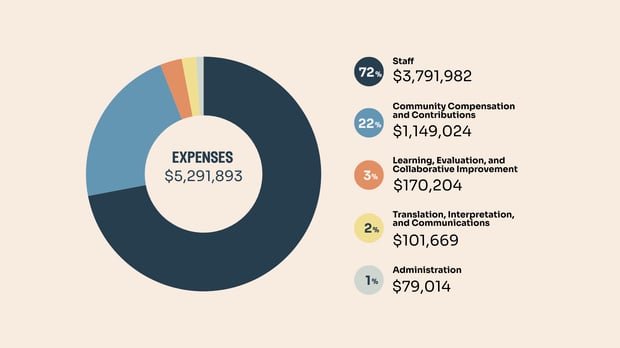 Staff: $3,791,982 – including staff salaries and benefits for the members of Tamarack’s teams: the Learning Centre, Networks for Change, Digital Sales Engagement and Learning, Public Policy and Resource Activation, Equity, Anti-racism and Reconciliation, People and Culture, and Finance and Operations.
Translation, Interpretation, and Communications: $101,669 – including translation and interpretation costs, publication and technology expenses.
Learning, Evaluation, and Collaborative Improvement: $170,204 – including travel, evaluation, coaching and workshops.
Community Compensation and Contributions: $1,149,024 – including honoraria for changemakers who contribute to webinars, workshops, tools, and publications; compensation for lived experience experts who participate in cohorts and communities of practice; operational grants for local communities; and innovation funds for local communities.
Administration: $79,014 – including audit, insurance, bank service charges, fundraising, and general operating expenses.
What this moment requires of us as we move to a new year.
We find ourselves at a time of profound uncertainty, increasing inequity, and a decline of trust and connection. The transformations we need require bold, collective action, not just within our communities, but across scales and within institutions and systems. At Tamarack, we believe that collective leadership is required as we all have a role in bridging divides, strengthening communities, and creating systems that serve all. In the years ahead, our work will continue to focus on the multi-layered approaches: People, Places, Policy and Movements.
People:
Places:
We will cultivate shared learning and action across networks.
Policy and Movements:
Our equity analysis tool will continue to guide strategy, resource development, and governance decisions so that equity is embedded in how we view change.

With the existing instability and deep grief in our system, we are grateful for the community of changemakers, including our donors, partners, members, and learners, for continuing to stand with us in this work. We are encouraged by your continued commitment to supporting place-based leadership and the relationships that make change possible. We are honoured to be in this work with you.