The Hamilton Roundtable for Poverty Reduction (HRPR) stands as a compelling case study in community-driven, systems-level change. Over its twenty-year history (2005–2025), the Roundtable has transformed Hamilton from a city with Ontario's second-highest poverty rate into a national and international leader in poverty reduction advocacy and policy innovation. Working in partnership with Tamarack Institute and drawing on the expertise of people with lived experience of poverty, HRPR has demonstrated how collaborative leadership across sectors, combined with a commitment to shifting mental models and addressing systemic barriers, can create measurable and lasting change.
Context: Origins and Partnership with Tamarack
The Hamilton Context (2005)
When the Hamilton Roundtable for Poverty Reduction was launched in 2005, Hamilton faced deeply entrenched poverty challenges. In 1996, Hamilton had the second-highest poverty rate in Ontario at 21.9%, affecting 101,190 residents. The city's economy had suffered from industrial decline, particularly the loss of steel manufacturing jobs, which devastated working-class communities and created persistent pockets of deep poverty. Health disparities mirrored income inequality: the Hamilton Spectator's landmark "Code Red" series (2010) revealed that residents in low-income neighbourhoods on the east side died on average 21 years earlier than those in affluent areas. It was against this backdrop that local leaders from government, the non-profit sector, business, and the community recognized the need for a coordinated, systems-level response.
Origins and Co-Conveners
The HRPR was co‑founded in 2005 by two key community leaders: the City of Hamilton and the Hamilton Community Foundation, specifically through the leadership of Carolyn Milne, then CEO of the Hamilton Community Foundation, and Joe‑Anne Priel, General Manager of Community Services for the City of Hamilton. This initiative emerged from “a deep concern that too many Hamiltonians were being left behind.” Early leadership was instrumental in shaping the organization’s collaborative philosophy. Paul Johnson, the Roundtable’s first Director (later City Manager of Toronto), emphasized that “this couldn’t be a single‑organization solution. It had to be the community leading together.” Mark Chamberlain, the inaugural Chair and a respected business leader, framed poverty not merely as a social issue but as an economic imperative: “Poverty is not just a social issue, it’s an economic one. If we ignore it, we do so at our city’s peril.”
Another influential voice during this period was former Hamilton‑Wentworth District School Board Chair Judith Bishop, whose steadfast advocacy helped keep the aspiration of making Hamilton the best place to raise a child front and centre. She championed this vision as a practical compass for policy, planning, and community action, reinforcing its power to unite diverse partners around a shared, future‑focused goal.
In the early days, this focus on children was a deliberate strategy. It opened up a new kind of conversation about poverty, one that centred shared responsibility rather than blame. We understood that children live within families and communities, and by anchoring the work in an aspirational statement, we invited Hamiltonians to see poverty not as something that happened to “others,” but as a challenge affecting the well‑being and future of the entire city. This shift created an important gateway for reframing the narrative: who is impacted by poverty, how it shapes community life, and what collective action could look like.
Partnership with Tamarack Institute
In 2005, as the HRPR was forming, Tamarack Institute was developing its Vibrant Communities initiative - a network of Canadian cities collaborating on poverty reduction. Tamarack, founded in 2002 by The J.W. McConnell Family Foundation and the Caledon Institute of Social Policy, emerged as the intellectual and strategic backbone for a national movement toward collective impact and systems change in poverty reduction. By the early 2010s, Hamilton became one of Tamarack's flagship communities, participating in the Vibrant Communities network alongside cities such as Calgary, Edmonton, and Winnipeg.
The partnership proved transformative. Tamarack provided several critical functions:
-
Peer Learning Networks: Tamarack connected Hamilton leaders to other communities tackling similar challenges, creating platforms for sharing innovations and lessons learned.
-
Living Wage Framework Development: When Hamilton partners sought to calculate the city's living wage in 2011, Tamarack developed the living wage framework for Canada that guided the Roundtable's calculation and subsequent advocacy.
-
Leadership Development: Tamarack brought Hamilton leaders, particularly Director Tom Cooper, to speak at national convenings, amplifying Hamilton's voice and positioning the city as a hub for the Canadian Basic Income movement.
-
Methodological Support: Tamarack championed the Water of Systems Change framework and collective impact approaches, which became central to HRPR's strategic thinking and helped the organization articulate how change occurs across multiple levels of systems.
Understanding Poverty: The Market Basket Measure
Before discussing HRPR's impact, it is essential to define poverty using Canada's official measure, the Market Basket Measure (MBM). The MBM was established as Canada's Official Poverty Line through the Poverty Reduction Act (2019) and forms the basis of the Government of Canada's poverty reduction strategy. According to Statistics Canada and the Treasury Board of Canada Secretariat, the MBM is an absolute measure of low-income that determines whether an individual or family lives in poverty based on their disposable income relative to the cost of a specific basket of goods and services.
The MBM basket includes five core components:
-
Food: Healthy, nutritious food appropriate to family size and dietary needs
-
Shelter: Rent or housing costs, including utilities and home maintenance
-
Clothing and Footwear: Seasonal and appropriate clothing
-
Transportation: Public transit or vehicle costs
-
Other Necessities: Childcare, telephone, internet, and items permitting community engagement
The basket costs are calculated for a reference family of four and adjusted annually for inflation and regional variations. A family is considered to live in poverty if its disposable income - income after taxes and mandatory deductions falls below the MBM threshold for its region and family size. In Hamilton specifically, the MBM reflects regional differences in housing costs, transportation infrastructure, and other local factors. For example, the Dictionary of the Census of Population 2021 notes that regional MBM thresholds are calculated based on actual costs of goods and services in each region, making the measure more accurate than national averages. For context, the Social Planning and Research Council (SPRC) data illustrates how the MBM compares to Ontario Works, Disability Support Program, minimum wage, and living wage in Hamilton:
-
Ontario Works (2024): $10,092 annually
-
Ontario Disability Support Program (2024): $17,052 annually
-
Minimum Wage (37.5 hrs/week, 2024): $30,676 annually
-
Market Basket Measure (2023, MBM-AT): $26,712 annually for a single person
-
Living Wage (Hamilton 2024): $41,006 annually
This comparison underscores a core finding of HRPR's advocacy: individuals on provincial social assistance live in "deep poverty," surviving on incomes far below the level needed to meet basic needs as defined by the MBM.
Key Changes and Impact Areas
The Waters of Systems Change: Shifting Policies, Practices, and Perceptions
Understanding the Framework
To understand HRPR's systemic impact, we must employ the Water of Systems Change framework, developed by FSG and advanced through Tamarack's work. This framework identifies six interdependent conditions that hold social problems in place, organized across three levels of explicitness:
Explicit Conditions (Visible Systems):
-
Policies: Formal rules, regulations, and laws
-
Practices: Activities, guidelines, and informal routines
-
Resource Flows: Allocation of money, information, and people.
Semi-Explicit Conditions (Relational Systems):
-
Relationships & Connections: Quality and structure of cross-sector collaboration
-
Power Dynamics: Distribution of decision-making authority.
Implicit Conditions (Transformational Systems):
-
Mental Models: Deeply held beliefs, assumptions, and narratives
The framework emphasizes that sustainable systems change requires addressing both visible and invisible conditions. Traditional approaches focus on surface-level fixes; the Water framework demands engagement with power imbalances and cultural beliefs that sustain inequity.
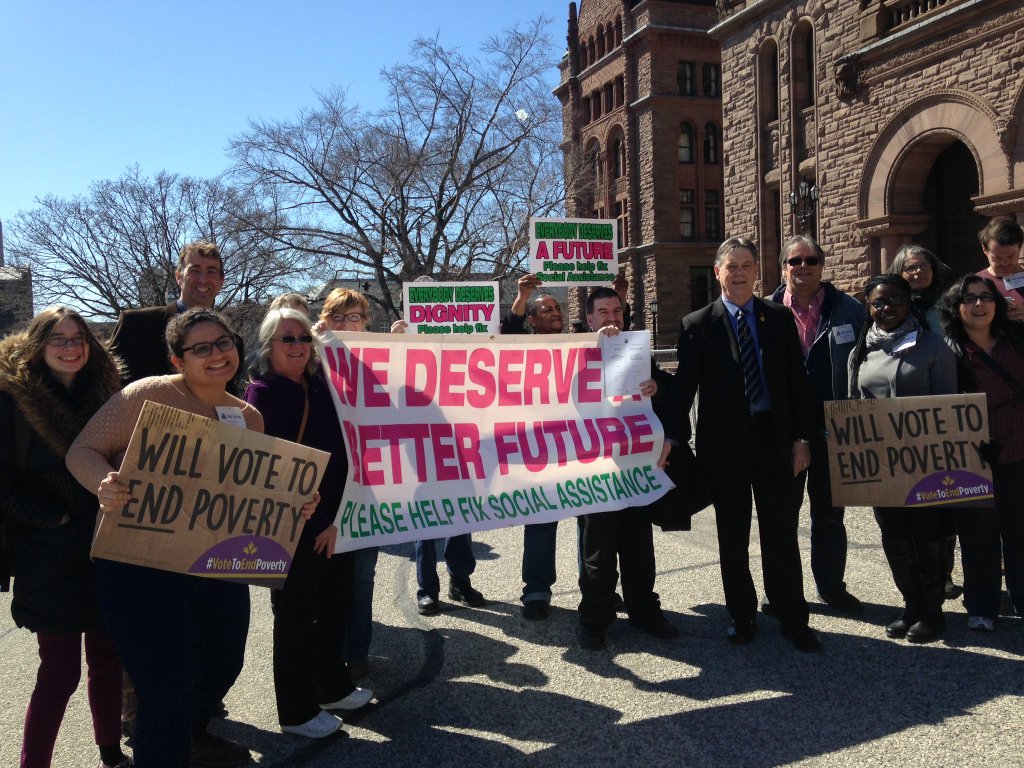
Mapping HRPR's Work to the Waters
Mental Models and Advancing Leadership
Shifting Mental Models Through Evidence and Narrative
A foundational insight underpinning HRPR's approach is that sustainable systems change requires shifting the deeply held beliefs and assumptions that maintain the status quo.
-
From "Poverty is Personal Failure" to “Poverty is Structural": Early in HRPR's history, public discourse treated poverty as resulting from individual failings, including lack of work ethic, poor choices, and addiction. Through data presentation (SPRC reports showing 1.8 million Ontarians living in poverty), narrative (Speak Now stories), and consistent messaging, HRPR reframed poverty as structural. When the Code Red series revealed 21-year life expectancy gaps between neighbourhoods, it made the structural nature of health disparities visceral. When surveys showed that 79% of social assistance recipients found employment services inadequate, it shifted blame from individuals to systems.
-
From "Living Wage is Utopian" to "Living Wage is Business Logic": In 2011, employers resisted living wage calculations as impractical. Yet Tom Cooper and other HRPR leaders worked with sympathetic business voices (like future Member of Parliament Matthew Green, who committed to paying a living wage at his gym) to demonstrate that paying living wages reduces turnover and increases productivity. By 2024, when the Hamilton Chamber of Commerce officially adopted a living wage policy, the mental model shift was complete - living wage was now viewed as smart business, not charity.
-
From "Basic Income is Radical" to "Basic Income is Serious Policy": When HRPR began advocating for basic income in the early 2010s, it was considered fringe. Yet through rigorous engagement in the Ontario pilot (2017–2018), documentation of positive impacts, and international advocacy, HRPR normalized basic income as a serious policy worthy of debate. Tom Cooper's work positioning Hamilton as the hub of the Canadian Basic Income movement, even after the pilot's cancellation, has kept the idea alive at national tables. Also, in October 2020, the Hamilton Chamber of Commerce teamed up with the Thunder Bay Chamber of Commerce to push basic income into the Canadian business mainstream. At the Canadian Chamber of Commerce (CCC) Virtual AGM, Hamilton advanced a policy resolution, co-sponsored by Thunder Bay, calling on the federal government to launch a basic income pilot project and to rigorously assess its costs, benefits, risks, and outcomes as a potential national approach to income support. The resolution was adopted by CCC delegates, making it an official CCC policy position that the national chamber could take to Ottawa as part of its advocacy agenda.
Developing Diverse Leadership
HRPR intentionally cultivated leadership across sectors and experiences.
-
Lived Experience Leadership Development: Through Speak Now and Living Proof training programs, HRPR provided skill development for people with lived experience to become public voices. This democratized expertise—recognizing that lived experience, combined with training and support, creates legitimate and powerful advocates.
-
Sector-Specific Champions: The Roundtable’s strength came from a broad constellation of sector‑specific champions, each bringing unique assets to the work. Business leaders such as Mark Chamberlain, a respected tech entrepreneur, and Howard Elliott and Dana Robbins from The Hamilton Spectator helped articulate the business case for poverty reduction. Philanthropic and non‑profit leaders—including Carolyn Milne at the Hamilton Community Foundation, Liz Weaver in her early leadership role, and later contributors such as Celeste Licorish, Laura Cattari, and Jennifer Chivers—added strategic insight, operational capacity, and deep community connections. Academics like Gary Warner provided research legitimacy, while faith leaders from the Anglican Diocese of Niagara contributed moral authority. Civil‑society advocates such as Deirdre Pike brought grassroots credibility and on‑the‑ground experience. Over time, directors and staff—including during Tom Cooper’s 15‑year tenure—helped carry this work forward and amplify Hamilton’s voice nationally, always as part of a wider team effort. This distributed leadership model ensured the work never rested on any single individual or sector; instead, it reflected the collective strength of a community where each leader leveraged their networks, expertise, and influence to drive whole‑community change.
Advancing Priority Domains of Work
Local Factors for Success
What enabled HRPR's sustained impact? Several local factors proved critical:
Political Will and Alignment
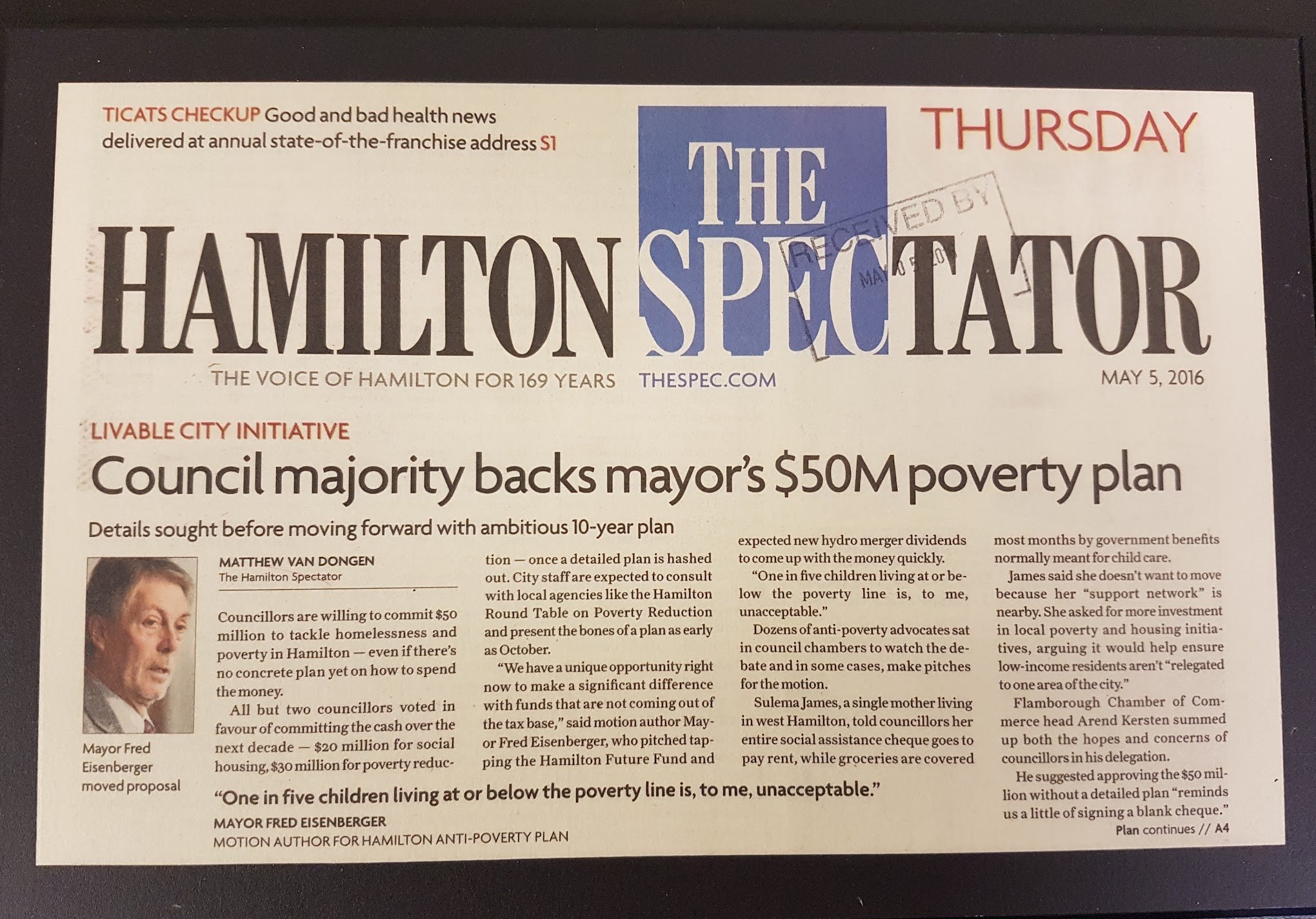
Hamilton's municipal government demonstrated sustained commitment to poverty reduction. The initial co-convening by the City and Hamilton Community Foundation, followed by Council's commitment of $50 million, reflected political recognition that poverty reduction was essential to civic health.
Diverse and Credible Leadership
The Roundtable benefited from leaders spanning sectors who brought both legitimacy and passion. Paul Johnson's collaborative philosophy, Liz Weaver's policy acumen, Tom Cooper's national voice, and Jennifer Chivers' administrative consistency provided continuity.
Research Partnerships
The Social Planning and Research Council provided rigorous data. Reports like Dont Stop Now! (2019) and The Faces of Poverty in Hamilton (2025) supplied evidence that advocacy could reference, creating a feedback loop between research and advocacy.
Tamarack's Enabling Role
As discussed, Tamarack provided frameworks, networks, peer learning, and methodological guidance that amplified local efforts.
Participation of People with Lived Experience
The insistence on embedding lived experience leadership transformed the organization. When people directly impacted by poverty shape strategy and represent the Roundtable publicly, credibility, authenticity, and accountability increase.
Long-Term Commitment
HRPR's sustained operation over twenty years (despite leadership transitions and political changes) demonstrated institutional commitment. Short-term funding cycles would have made this impossible.
Tamarack's Contribution and National Context
Tamarack's Specific Contributions
Tamarack Institute's support operated at multiple levels:
-
Methodological Framework: Tamarack championed the collective impact approach and, later, the Water of Systems Change framework. These frameworks gave HRPR language and structure to understand and articulate its work - moving beyond intuitive collaboration to intentional systems change strategy.
-
Living Wage Framework: When HRPR partners sought to calculate the city's living wage in 2011, Tamarack developed the living wage framework for Canada that served as the calculation's foundation. This knowledge transfer ensured methodological rigour and enabled replication across communities.
-
Peer Networks: Through Vibrant Communities Canada, Tamarack connected Hamilton to a network of cities - Calgary, Edmonton, Winnipeg, Saint John, St. John's, and others, all advancing poverty reduction. These connections created opportunities for learning, shared problem-solving, and mutual accountability.
-
Leadership Development and Amplification: Tamarack brought Tom Cooper to national convenings, amplifying his voice and positioning Hamilton as a hub for the Canadian Basic Income movement. When Tamarack was supporting Eastern Canadian communities interested in basic income, the organization brought Tom in to share Hamilton's learnings, a powerful form of peer teaching.
-
Knowledge Integration: Tamarack helped translate Hamilton's practical experience into generalizable knowledge - producing case studies, practice guides (like Engaging People with Lived/Living Experience of Poverty), and research that other communities could adapt.
-
International Connections: Through Tamarack networks and directly, HRPR gained access to international practitioners - connections to the Living Wage Foundation in the UK and other global networks that guided the movement forward.
Hamilton's National Influence
By the early 2020s, Hamilton had become a reference point for national poverty reduction work:
-
The 2017 "Leadership in Poverty Reduction Award" from Vibrant Communities Canada recognized HRPR's stellar leadership.
-
Speak Now Hamilton's model influenced speaker bureaus in other communities.
-
Hamilton's living wage advocacy contributed to the normalization of the living wage in Canadian discourse.
-
Hamilton's participation in the Basic Income Pilot—and HRPR's subsequent advocacy—kept basic income alive nationally despite the pilot's cancellation.
-
The payday lending bylaw sparked similar regulation in other Ontario municipalities.
-
HRPR's UN submissions contributed to Canada's international human rights accountability.
Lessons Learned
Systems Change Requires Long Time Horizons
HRPR's major achievements, living wage normalization, basic income pilot participation, and payday lending regulation took 10–15 years of consistent advocacy. Policy change is rarely rapid; sustainable transformation requires patience, persistence, and institutional memory.
Embedding Lived Experience Changes Organizations
The decision to make social inclusion policy foundational, ensuring people with lived experience held decision-making power, proved transformative. This practice distinguished HRPR from organizations that consulted with marginalized communities without sharing power. It also improved decision quality, as those most impacted by poverty shaped the strategy.
Collaboration Across Sectors Multiplies Impact
HRPR's power is derived not from any single organization but from the alignment of government, business, nonprofits, faith, academia, and citizens. Businesses adopted a living wage, the government created affordable transit passes, and non-profits provided services informed by the Roundtable strategy. This multiplier effect could not have occurred without cross-sector collaboration.
Narrative and Testimony Shift Mental Models
While data and policy briefs are necessary, they are insufficient. HRPR's insight, making storytelling central to advocacy through Speak Now and Living Proof, recognized that people change their beliefs through narrative and encounter with humans, not through statistics alone.
National Networks Amplify Local Work
Without Tamarack and other networks, HRPR's work would have remained local. Networks that amplify local voices, create peer learning, and position communities as leaders multiply impact and create conditions for innovation to spread.
Flexibility and Adaptation Are Essential
HRPR adapted as circumstances changed from a focus on living wage in 2011, to basic income in 2015–2018, to employment services reform and mental health in 2025. Rigid adherence to original strategies would have been counterproductive; flexibility kept work relevant and responsive.
Ripples of Impact Beyond Hamilton
HRPR's influence extended far beyond the city:
-
Ontario Living Wage Network - Co-founded by HRPR, the Ontario Living Wage Network now includes 30 communities. By establishing and sharing a methodology, HRPR enabled the living wage movement to scale. As of 2025, a living wage is increasingly normalized across Ontario.
-
Basic Income Discourse - Though Ontario's pilot ended in 2018, HRPR's advocacy through the Living Proof Speakers Bureau, documentary work, and Tom Cooper's national platform kept basic income alive in Canadian discourse. The 2024 Basic Income Guarantee Forum in Ottawa, which HRPR helped co-coordinate, demonstrated ongoing national interest.
-
Payday Lending Regulation - Hamilton's 2018 payday lending bylaw inspired similar regulations across Ontario municipalities. HRPR demonstrated that predatory lending, once accepted as inevitable, could be regulated and reduced.
-
Models of Lived Experience Leadership - HRPR's Social Inclusion Policy and Speak Now/Living Proof bureaus have been studied and adapted by other poverty reduction initiatives across Canada. The Tamarack guide, Engaging People with Lived/Living Experience of Poverty, codified and shared these practices nationally.
-
Research and Evidence - SPRC reports emanating from Hamilton, Dont Stop Now! The Faces of Poverty in Hamilton, and others, contributed to the national understanding of poverty trends and policy effectiveness.
-
International Advocacy - Through UN submissions, Hamilton residents influenced Canada's human rights reviews and contributed to global conversations about poverty, rights, and dignity.
Next Steps and Future Directions
Continuing Challenges
Despite progress, significant challenges persist:
-
Food Insecurity: 20% of Hamiltonians lived in food-insecure households in 2023, a troubling indicator despite declining overall poverty rates.
-
Housing Crisis: Affordable housing waiting lists extend 3+ years; 45% of renters live in unaffordable housing.
-
Social Assistance Rates: Ontario Works and ODSP remain frozen at inadequate levels, consigning recipients to deep poverty.
-
Employment Quality: Despite job availability, much employment is precarious, low-wage, and without benefits.
HRPR's Evolving Strategy
In its third decade, HRPR is transitioning its governance structure and deepening work on interconnected issues:
-
Systems Integration: Moving beyond siloed advocacy to address how housing, employment, health, and income systems interact to keep people in poverty.
-
Power and Equity: Deepening attention to how racism, gender, disability, and immigration status compound poverty's impacts.
-
Community Leadership Transition: Supporting new cohorts of lived-experience leaders to sustain advocacy beyond founding cohorts.
-
Data and Storytelling: Continuing to integrate rigorous data with powerful narrative.
Policy Recommendations: People Not Pillars
HRPR's 2025 policy brief, People Not Pillars (submitted to Ontario's poverty reduction strategy renewal), synthesizes two decades of learning. Core recommendations include:
-
Income Security: Set social assistance rates to a livable amount, indexed annually.
-
Housing: Expand universal, portable rent supplements (Manitoba model) and commit to affordable housing investment.
-
Employment: Recreate Employment Ontario, focused on skilled jobs with longevity and career pathways.
-
Supports and Services: Fully fund mental health services, childcare, telephone/internet, and transportation equally across regions.
-
Financial Resilience: Stack all benefits and credits until the poverty line; raise earnings exemption limits; reduce administrative burden.
Conclusion
Over twenty years, the Hamilton Roundtable for Poverty Reduction has demonstrated that sustained, collaborative, systems-level change is possible. Launched amid Hamilton's second-highest provincial poverty rate (21.9% in 1996), HRPR has helped drive poverty down to approximately 9.9% by 2023, a decline of over 54%. This transformation was not the result of a single intervention or policy change. Rather, HRPR worked intentionally across the Water of Systems Change, shifting mental models about poverty's causes and solutions, redistributing power to include people with lived experience as decision-makers, building cross-sector relationships and collaborations, redirecting resource flows toward poverty reduction, changing practices in employment and lending, and advancing policies at municipal, provincial, and national levels. Critical to this success was a partnership with Tamarack Institute, which provided frameworks, networks, peer learning, and methodological guidance that amplified local efforts and contributed to scaling innovations nationally.
Yet significant challenges remain. Food insecurity, inadequate housing, frozen social assistance rates, and precarious employment continue to trap people in poverty. The fact that individuals in receipt of provincial social assistance live in "deep poverty," surviving on incomes one-third below the MBM threshold, underscores the urgency of ongoing reform. As HRPR enters its next phase, its challenge is to build on twenty years of accomplishment while deepening systems change, addressing the interconnections between housing, employment, health, and income that keep people poor; centring the voices of those most impacted; and maintaining commitment to long-term transformation despite political cycles and funding pressures.
HRPR's legacy is not merely the policies changed or the rates reduced, though these matter profoundly. Its legacy is demonstrating that when communities — government, business, nonprofits, faith, academia, and people with lived experience — pull together with shared commitment to justice over charity, to systems change over band-aids, to the long view over quick fixes, sustainable transformation becomes possible. In Hamilton, two decades of collaborative effort have proven that another approach is achievable — one where everyone has the resources and opportunity to thrive.













%20(1).jpg)