
Last year, we launched the Changemaker Self-Assessment, a reflection tool to build awareness of the five interconnected skills needed to make community and systems change. The short quiz allows you to see where your strengths and opportunities lie within the interconnected skills.
One year later, we’ve heard from over 200 people. What does the collective data say? The key take away: The "heart" skills (trust-building, humility, collaborative leadership) are well-developed, while the "proof" skills (data collection design, evaluation frameworks, systematizing what's learned) lag behind.
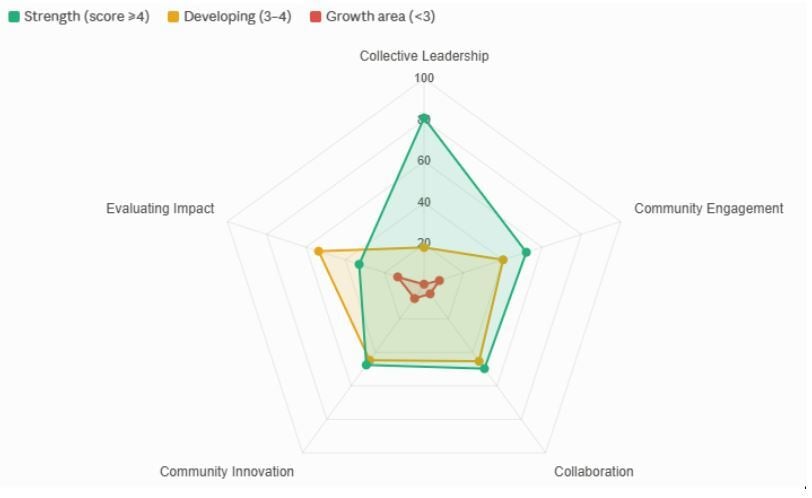
Visualized results from the Changemaker Self-Assessment showing respondents were most comfortable with their collective leadership skills, developing their impact evaluation skills,and want to grow their community engagement skills.
Top strengths
Highest-rated statements, all from Collective Leadership and Community Engagement
"I see relationships as a key catalyst for complex systems change"
"I am a perpetual learner with a continuous improvement plan"
"I am mission-driven, and people-centric"
"I work to cultivate relationships, build awareness, empathy, and trust with diverse community members"
Biggest growth areas
Lowest-rated statements, dominated by Evaluating Impact and Community Innovation
"I design and implement robust data collection methods to capture diverse perspectives and experiences"
"I create customized evaluation frameworks that align with the unique contexts and needs of programs"
"I facilitate participatory processes to co-create theories of change"
"I have experience helping successful prototypes become part of regular practice or policy"
"I have systems in place to capture and share lessons learned with others"
It is interesting that some of the capabilities changemakers identify as their greatest strengths may also be among the least visible, least measured, and least explicitly resourced parts of their work. The so-called "soft stuff". It may also be easier to self-rate these as higher since they are phrased as broad statements rather than specific actions.
There's a clear theme in the low end: the technical, methodological side of evaluation (data collection design, custom frameworks) and the "close the loop" side of innovation (institutionalizing prototypes, systematizing lessons learned) are where people feel least confident — even when the relational and mission-driven parts of the same domains score reasonably well.
From this dataset, we see a group of relational, mission-driven leaders. This gives us tremendous hope because relationships accelerate change, and motivation, combined with local assets are the fuel we need.
Why this matters to us: We believe that by building the skillsets, mindsets, and relationships that enable aligned action, communities will be more equipped to respond to crises, close equity gaps, and build vibrant communities.
We invite you to take the self-assessment, build a learning plan individually and across your team, and be sure to check out our Individual Membership for on-going support from our team.