Based on a conversation with Climate Justice Montreal, interviewed by Erika Massoud and Chúk Odenigbo at the Tamarack Institute, this article is part of a series reflecting on the experiences of groups who participated in the Community of Practice for Collective Climate Transitions (CPCCT), organized by the Tamarack Institute in partnership with the Foundation of Greater Montreal.
Climate Justice Montreal (CJM) is a grassroots collective working toward an Indigenous-led just transition away from fossil fuels. The collective envisions climate justice as a pathway to connect struggles that are too often treated separately. As climate change affects every aspect of our lives, CJM believes connecting the dots between movements will enable us to address the impacts of climate change while leaving no one behind.
From CJM’s perspective, climate justice requires bringing together decolonial, anti-racist, migrant justice, accessibility justice, housing, free transit, and community-led social movements to address the roots of the climate crisis and the systems that reinforce inequality. CJM’s work reaches across the island of Montreal and increasingly beyond it. Through coalition-building and advocacy campaigns, the collective works with movements around common values of affordability, mobility, and climate justice.
Connecting the Issues
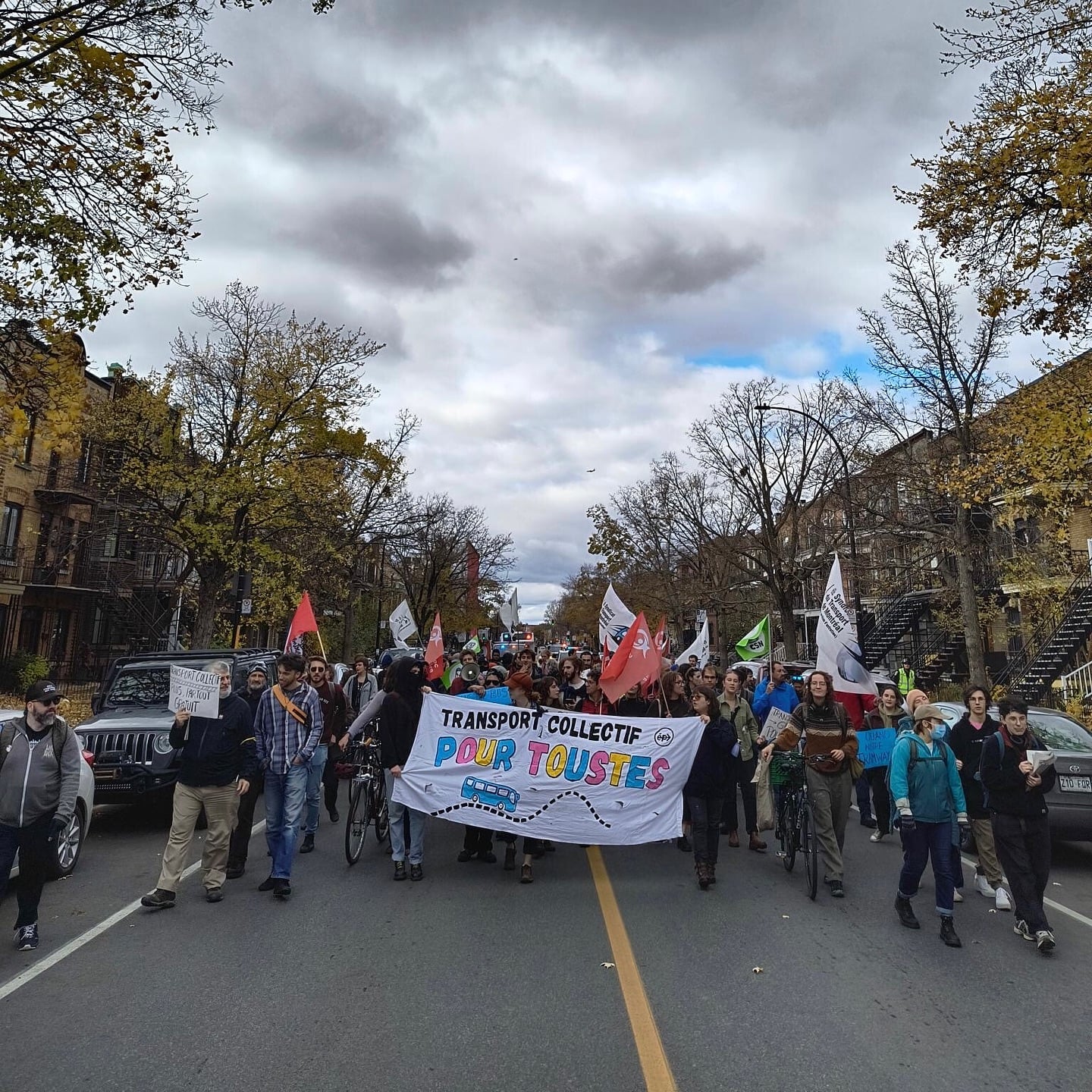
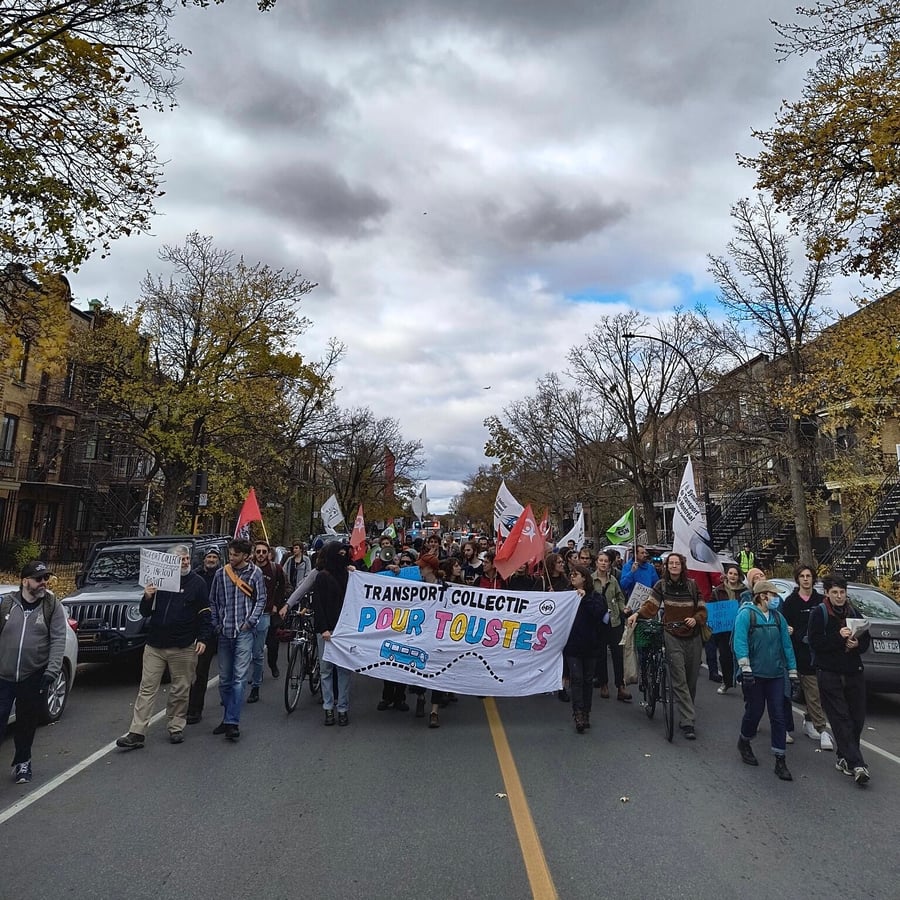
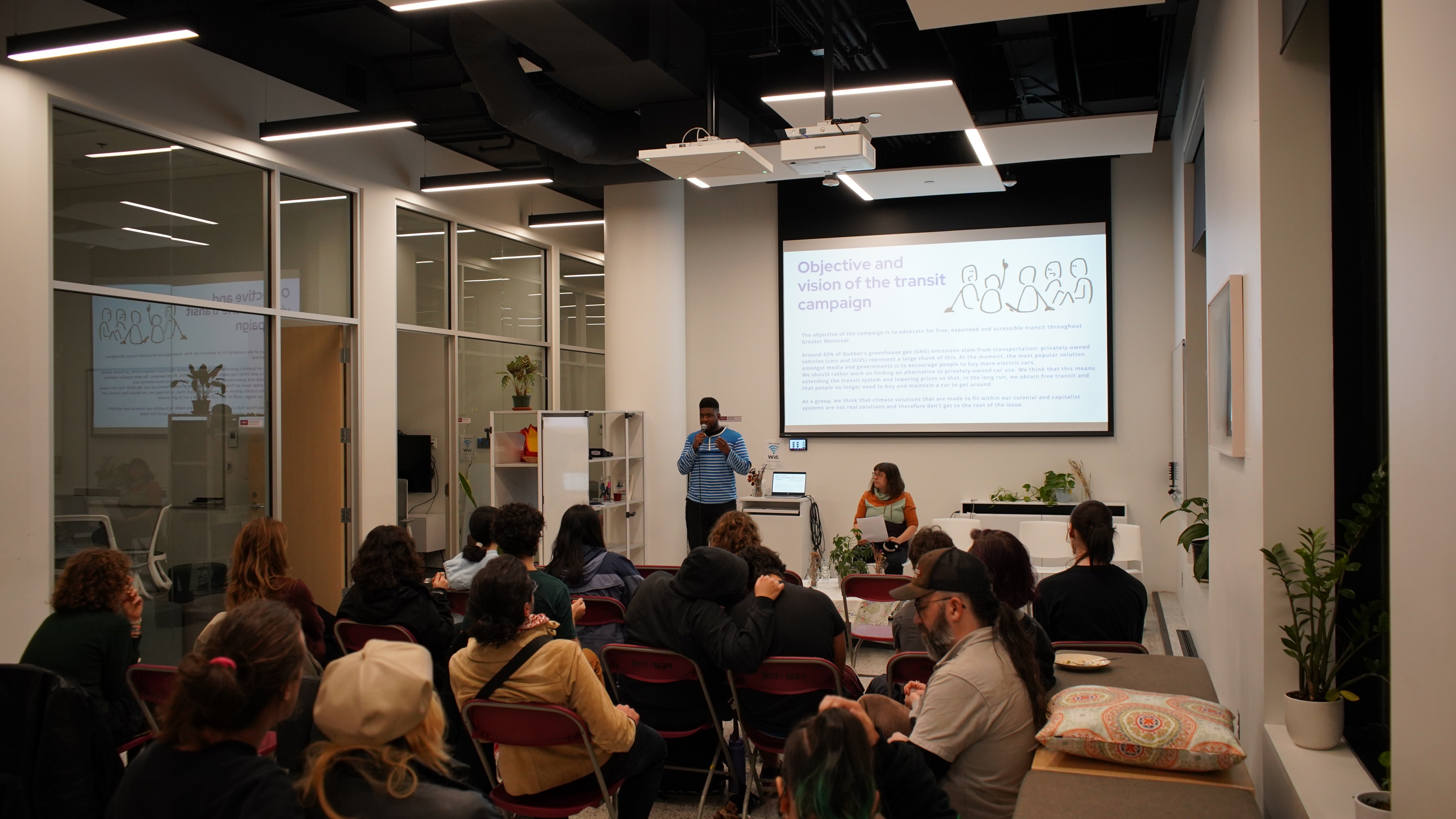
At a time when the climate movement is losing visibility, one of Climate Justice Montreal’s most important roles is helping people see how seemingly different social issues connect. The collective’s current campaigns focus on free, accessible, and expanded public transit in Montreal, as well as exposing the risks of artificial intelligence as a false solution to climate and social crises. These campaigns respond to very immediate concerns: the rising cost of living, car dependency, impacts of climate change, technological harms, and the need for public systems that serve communities.
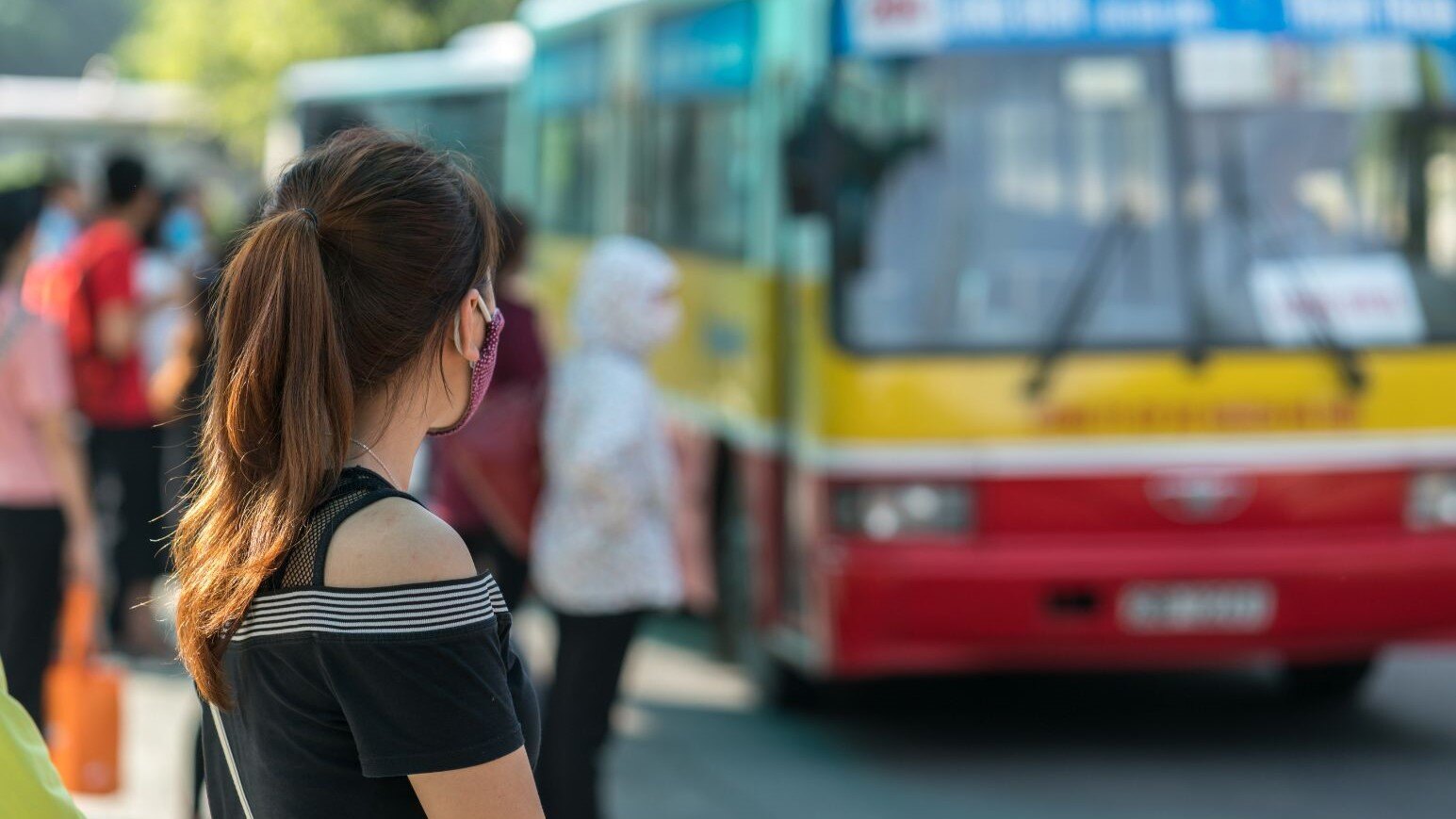
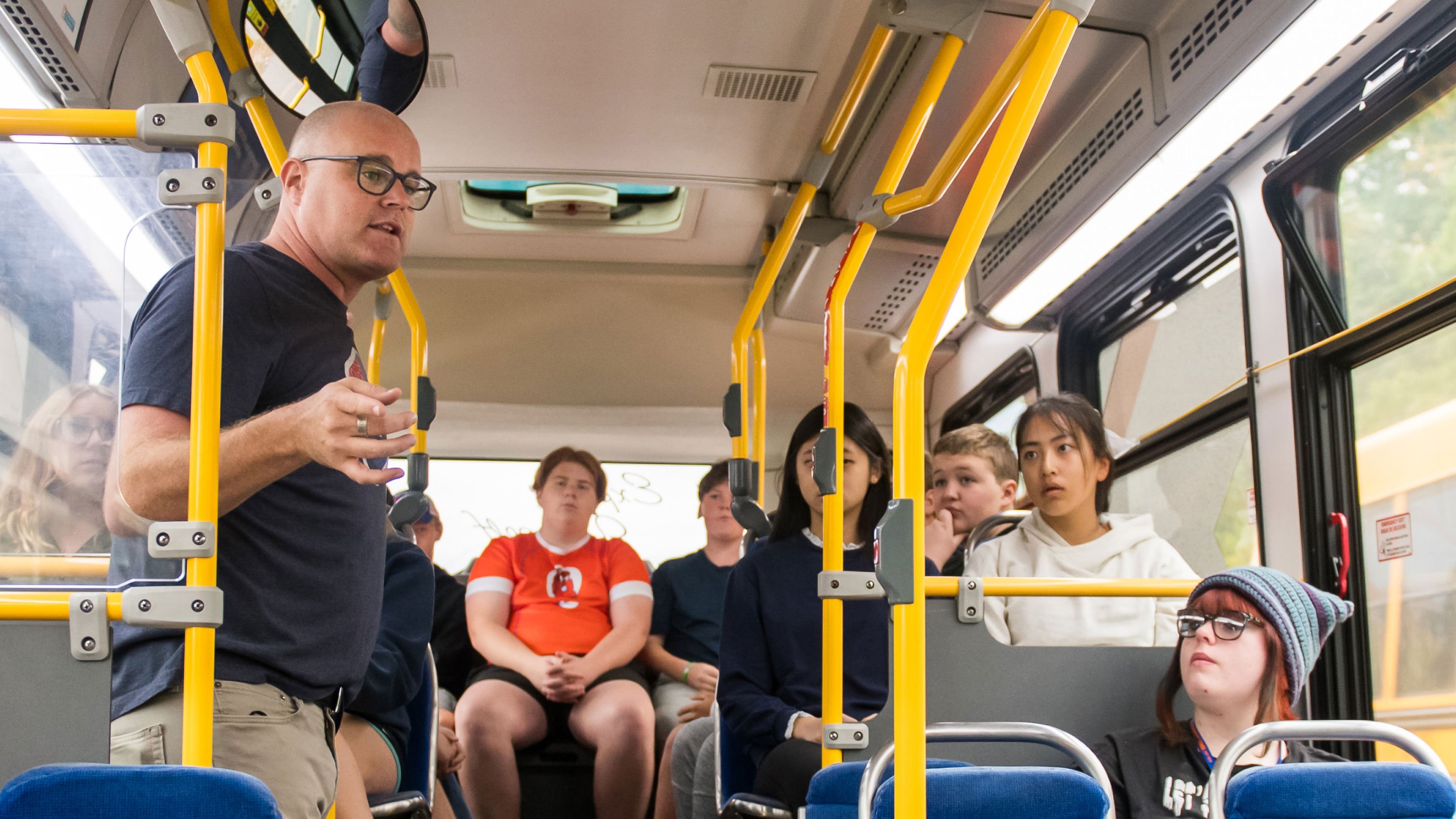
For CJM, public transit more than just a transportation issue. It is about ensuring public transit is affordable and accessible, in order to break isolation and increase mobility. One of their priorities is to advocate for free transit for youth under 18 and build targeted coalitions with families, youth-serving organizations, climate groups, and community partners to advance this goal. At the same time, the collective holds the following tension: how can Montreal expand transit to marginalized neighbourhoods without accelerating gentrification or displacing the very communities that would benefit?
To explore this tension, CJM is joining a research and advocacy cohort with other Montreal-based organizations to explore how the city can become more accessible and livable without displacing communities.
What the Community of Practice Offered
CJM joined the Community of Practice for Collective Climate Transitions (CPCCT), organized by the Tamarack Institute in partnership with the Foundation of Greater Montreal, because it offered the opportunity to connect with other groups, share their work, and learn from others facing similar challenges. This opportunity was especially relevant given that CJM’s transit campaign is deeply coalition-based.
Importantly, many of the groups participating in the community of practice are grassroots, community-led groups or movements who do not have paid staff, similarly to CJM. In that context, alternative forms of support centered around relationship-building, skills and tool sharing, tailored support, and strategic connections, which can be just as important as funding, according to CJM. Some of the tools shared were used as a springboard for CJM’s own visioning process, including exercises related to social change ecosystems.
The Limits of Connection Without Capacity
Fluctuating capacity remains a major barrier for CJM’s work. Campaigns often have clearer tasks and more stable participation, while the movement as a whole experiences frequent turnover. This makes it difficult to sustain the internal care practices, communication processes, and structures that support long-term movement work.
CJM observed that many groups in the community of practice were struggling with similar issues and having difficulty breaking through silos. This observation was both validating and concerning for CJM, as it pointed to a larger issue: grassroots groups are often expected to collaborate, advocate, run programs, fundraise, and care for one another in systems that do not adequately resource any of those activities. How do we create a culture of abundance and communities of care in this context?
What Funders and Institutions Can Learn
When asked what grassroots movements need from foundations, municipalities, and larger organizations, CJM’s answer began with listening and relationship-building. Funding matters, but the material support that groups need will look different depending on their context. Some collectives may need money and be ready to run with it. Others may need grant-writing or administrative support, strategic connections, research capacity, or relationships that help them move from service provision toward broader advocacy and systems change.
The current funding environment is a structural challenge for non-profit organizations and community groups alike. Grassroots movements often operate in scarcity, competing for limited resources instead of being supported to collaborate. This scarcity contributes to silos, even when groups know they need one another to make meaningful change. Many organizations are doing essential service provision and mutual aid, but without an advocacy arm, those efforts can remain isolated from the systems change needed to address worsening social and climate conditions.
For CJM, foundations that want to support more radical grassroots work need to see themselves not only as funders, but as accomplices. That means building trust, being flexible, and understanding the constraints grassroots groups face. It also requires moving financial, human, and other resources strategically in ways that strengthen movements rather than simply funding isolated projects.
Looking Ahead to Build Convergence Across Movements
A recurring theme in CJM’s reflections was the need for movements to build trust across difference. They described the work as “swimming upstream”: too often, movements are fighting to stop things from getting worse rather than creating the conditions for a better world. In this context, climate movements have a responsibility to meaningfully support struggles that are deeply connected to climate justice.
CJM noted the need for climate-focused groups to address white supremacy and entitlement in climate work, and the tendency to treat climate change as separate from social justice. If climate groups approach other movements only when they need support, without building trust or understanding shared roots, convergence will remain shallow.
Real collaboration requires political maturity: the ability to acknowledge harm, work across tension, and stay focused on the bigger picture even when relationships are imperfect. Building trust requires acknowledging historical and ongoing pain and conflict. It means recognizing that movements are interconnected and that no single organization or campaign can address the climate crisis on its own.
CJM’s reflections offer an important reminder for those seeking to support grassroots climate justice work: movements need more than one-off funding, occasional convenings, or abstract learning spaces. They need the capacity and time to build relationships, gain concrete tools and flexible resources, and receive support from partners willing to understand the structural conditions they are working within. Above all, CJM aims for institutions and movements alike to recognize that climate justice is inseparable from the broader struggle for collective liberation and systemic change.
Learn More
-
Visit the Climate Justice Montreal’s website
An artificial intelligence tool internal to the Tamarack Institute was used to assist with transforming the transcription of this interview recording into a text format. The final version of the text was modified, corrected, and approved by the Tamarack team and the communities involved.