
Written by Danya Pastuszek with Sylvia Cheuy, Lisa Attygalle, Jorge Garza and Alison Homer
In the spring of 2026, Tamarack was invited to share learnings about its work on belonging in eight different places in the US and in Canada. The thoughts below are a curation of ideas we shared at these events. They are possible because of the communities we’re in partnership with.
In this article
-
Why belonging matters now
-
Defining belonging: A stance, outcome, act, and design principle
-
The mindset shift needed to embed belonging into existing strategies
-
Belonging AND: Examples
-
Tensions that make this work hard
-
Leverage points
Why belonging matters now
Tamarack’s work is about ending poverty in all its forms.
One type of poverty is loneliness: the poverty of connection to others. To address this type of poverty, we focus on building belonging in local systems and communities.
The context for how we’re experiencing belonging right now is sobering, and – like so many other trends – is not abstract. It’s felt by people in the places where they spend their time.
In Canada, a Quality of Life Framework headline indicator shows that less than half of Canada’s population (48%) reported a very or somewhat strong sense of belonging to local community in 2025.
People from equity-denied communities are disproportionately impacted by systems that don’t enable belonging. For example, Statistics Canada’s 2025 report Community and well-being: Exploring sense of belonging among youth reported that youth who were in urban areas, part of the 2SLGBTQ+ community, or living with a disability, were less likely to report a strong sense of belonging than their peers.
Across the world according to the 2026 Edelman Trust Barometer, we are becoming more insular and less trusting of institutions. We’re also becoming less trusting of each other: seven in ten people report being unwilling to trust people who they perceive as different from them - and they are actively working to make things worse for them.
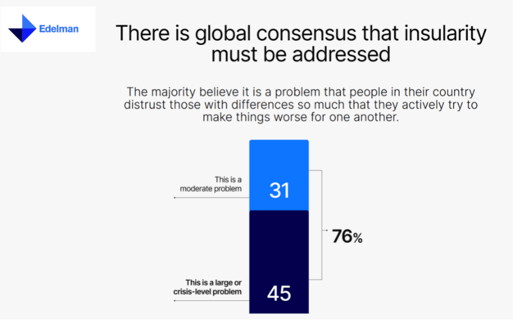
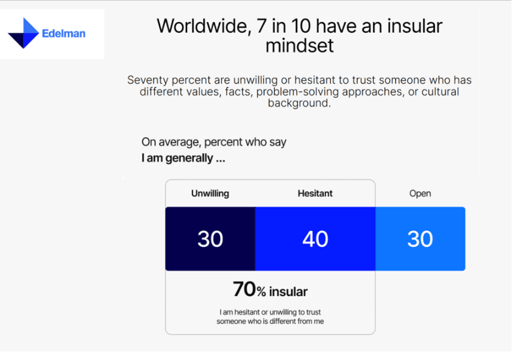
From the Edelman Trust Barometer, 2026
Yet we have hope, because three in four people see this trend as deeply concerning. Every day at Tamarack we see examples of how people are coming together across experiences, sectors, and passions to solve complex and interconnected problems.
A problem of framing
As we connect with people concerned about the trends, we often hear things that sound like “we are living through an epidemic of loneliness.”
That framing is uncomfortable.
When we call loneliness an epidemic, we turn it into a disease. Something clinical. Something solved one person at a time.
It’s easy to picture individuals struggling - with friendships, with screens, with substances, with motivation - and to conclude that the solutions are also individual. Go meet people. Put down your phone. Go to rehab. Find a therapist.
What this misses is that loneliness – and the absence of belonging - is fundamentally a systemic design problem. Loneliness - in rural places and urban ones, in the US, in Canada, and in other places around the world - is a result of how we have built our communities, our economies, our institutions, our public spaces, and our policies.
To meet this moment, we need to tell a different story – a story that belonging and the social infrastructure that enables it are not “nice to haves.” That belonging is not something that we create after people have reached the depths of despair. Belonging is a prerequisite for well‑being, learning, economic opportunity, and democracy itself. Creating belonging and the infrastructure that enables it does not sit with one sector, one profession, or one program. It takes leadership that is shared, place-based, and operates across difference, sectors, and scales.
Defining belonging and social infrastructure
Our definition of belonging comes from two years of work on the Canada-wide Strategy for Belonging. Through work with 9,000 local leaders across Canada, we have come to think about belonging in four interconnected ways: This stance is about cultivating networks of relationships, practices and commitments that, together, create a culture of belonging
-
An outcome - a vital condition for human flourishing and collective resilience.
-
An act - something we do, with hope, rigour, and continuity
-
A design principle - central to how we gather people to understand problems and reimagine what is possible
What creates the conditions where belonging can happen repeatedly? Social infrastructure, which consists of:
-
Trusted relationships across sectors and lines of difference
-
Shared spaces where people gather with purpose
-
Common language, shared data and information, and ways to understand problems, possible futures, and each other
-
Access pathways that create opportunities for residents to engage, influence and benefit.
The mindset shift needed to embed belonging into existing strategies
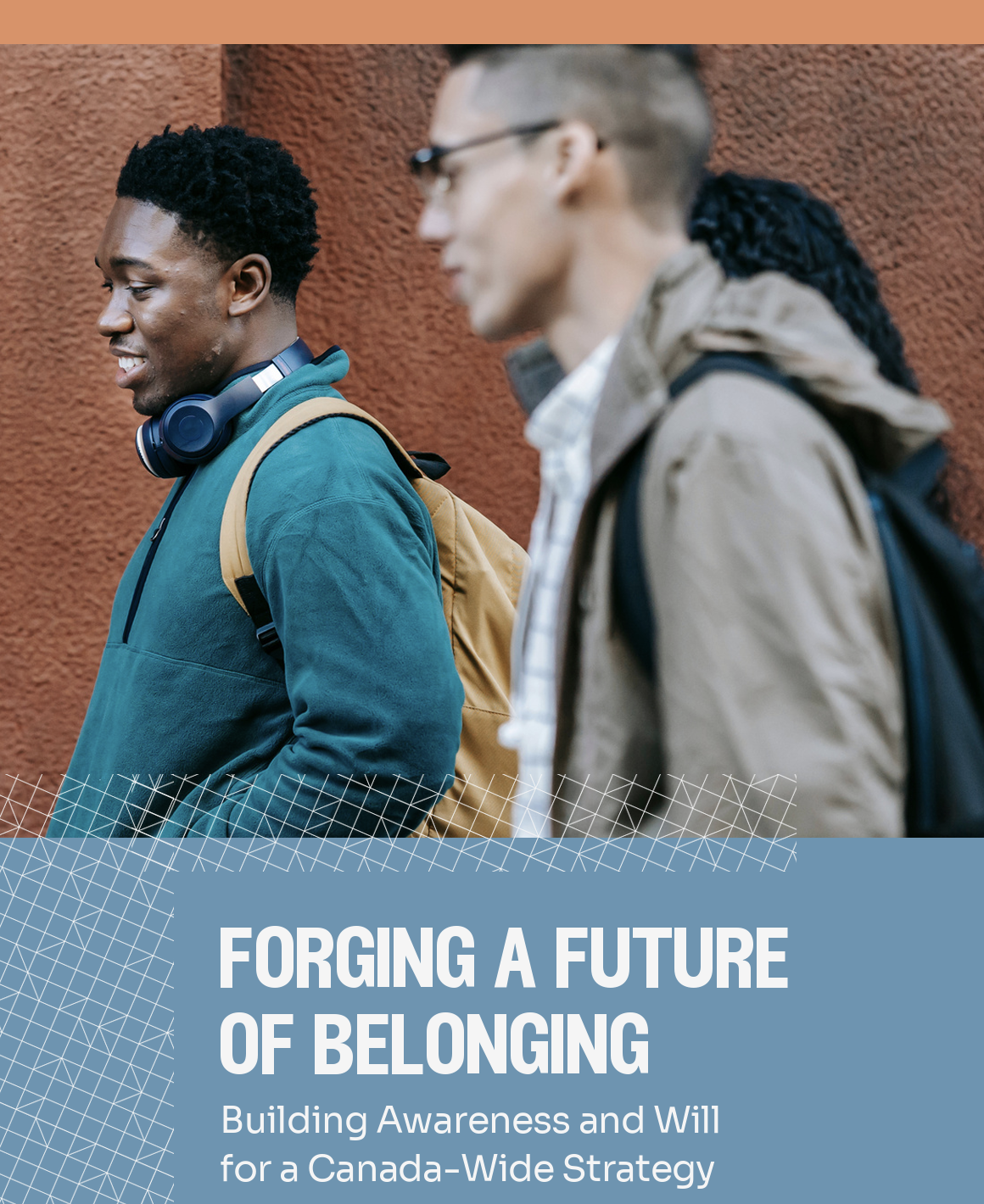
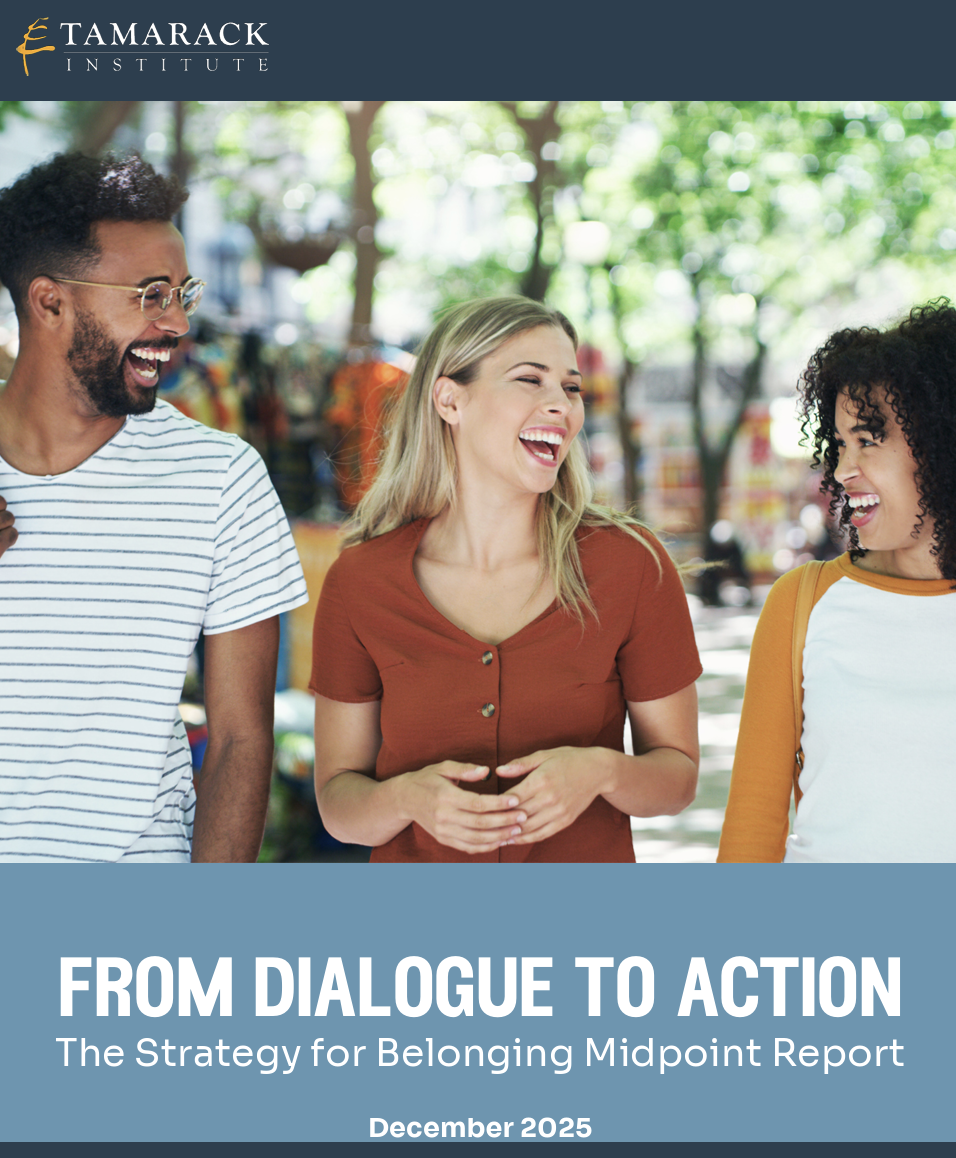
Over the past two years, we’ve engaged with 9,000 people across the communities we partner with on what it looks like to build social infrastructure for belonging, and to unpack the conditions that enable belonging. To date, we have published two reports documenting this work.
 |
 |
The most significant learning from this journey is that belonging is best approached not as an isolated outcome, but as an enabler of priorities like economic mobility, early childhood development, high school graduation, workforce attachment, and housing security. It’s not a separate strategy. It’s not about belonging OR but belonging AND.
So, what does a focus on belonging AND…look like?
Examples of embedding belonging into cradle-to-career work
-
A powerful example comes from New Westminster, British Columbia, one of our active 2024 Circle of Actions cohort members. By securing unanimous endorsements from both the New Westminster Homelessness Coalition Society Board and the WINS Local Immigration Partnership Council. Belonging unites distinct sectors, helping to lay the local foundations for a cohesive, national movement.
-
It looks like the Roving Campus alternative education initiative for Grade 12 students not on track to graduate that provides free transportation to school, fosters relationships at school and in the community, and creates personalized education opportunities, so that in the first year of the initiative,100% of their students graduated and also received professional accreditations and 80% secured summer employment. The initiative increased the city’s overall graduation rate by 6% over 4 years. Belonging enables high school graduation.
-
It looks like a large-scale career and employment expo in the Yukon that convenes employers, funders, government, post-secondary institutions, and youth-serving organizations — paired with accessible certifications and skill-building workshops (Food Safe, CPR) to reduce barriers. This project is grounded in a deeper systems question: what helps young people stay, work, and belong in their communities? This framing connects employment to retention, transportation, internet access, health services, food costs, and recreation — the real conditions that shape opportunity.
-
It looks like working with the government to expand their indicators of success for young people to include indicators like the number of trusted adults a young person has access to, and their degree of social isolation. Belonging is about recognizing the upstream conditions for youth success.
-
It looks like a young person being able to text their coordinator for a quick pep talk before walking into a boardroom of adults. The Northfield Healthy Community Initiative in Minneapolis, MN offers a Youth on Boards initiative that gives young people a place on every municipal board. Importantly, the process for youth stepping into these roles includes a trusted relationship. Belonging is having the allyship to confidently use our voice.
-
It looks like Golden, British Columbia, where a local business owner convenes the city’s poverty reduction effort and partners at the leadership table put aside traditional roles based on sector to decide together what each partner needs to do. Belonging welcomes new roles and asks, what gifts do you bring?
-
It looks like the Good Neighbour Kitsilano Initiative in British Columbia that activates trusted residents as “block connectors” to connect neighbours and create a grassroots response to emergency preparedness, so that in times of emergency, no one is left behind. Belonging recognizes it’s not “what you know” it’s “who you know”.
-
It looks like Eshkiniigijig Radio in Deshkan Ziibing - Chippewas of the Thames First Nation, a youth-led radio station where young voices, Indigenous culture, and community come together on the airwaves. This initiative was seeded in their poverty reduction efforts and youth strategies because identity, language, and culture are essential to positive community outcomes.
what makes this work hard
Belonging is easy to overlook when we’re busy, stressed, or feeling a sense of scarcity.
- Relationships take time to build - Relationships aren’t built until people feel seen, heard, and believe their contributions are essential. That doesn’t happen until we take time with each other. Maurice Sendak once described Terry Gross as having “a rare quality of presence and listening that made people want to say the things they usually keep locked away.” That’s what we’re trying to create in our work: spaces where people feel safe enough, respected enough, to be honest about what’s really going on. When we skip this, we might get participation, but we don’t get shared ownership. And without ownership, work doesn’t hold.
- Relationships don’t scale - We can’t double or triple the number of relationships we hold and expect the same depth. So the question becomes: how do we grow networks of relationships where trust can live? And, how to create a culture where building relationships is seen as essential and foundational? That work is slower, more distributed, and ultimately more resilient.
- People are more comfortable with people they know - If we’re serious about changing systems, we have to have and stay in conversations where not everyone sees the world the way we do. Belonging means creating conditions where difference lives. It means rethinking who is in the room, who is shaping decisions, and whose knowledge is centred.
- It’s difficult to admit we don’t know or may have been wrong – Vulnerability is hard (especially for leaders), but essential to establish belonging. We need to let ego go. To sit with uncertainty, to say what we don’t know yet, and to be willing to learn with others. Belonging is often built in moments when people feel that they don’t have to act certain and when – as we share in Seeds of Transformation: A Loving Framework for Equity, Reconciliation and Belonging – we can make that journey together.
- The scale of the issues is large, and there is pressure to standardize, yet every community and person is unique – Impactful change is the result of a suite of solutions that are aligned and that leverage local assets.
Leverage points
How do we respond to these tensions? The leverage points are not single programs or isolated interventions. They are shifts in how we design systems, structure relationships, distribute power, and define success.
-
Make Time to Build Trust – Trust is not a byproduct of collaboration; it is foundational infrastructure. Mutual understanding, consistency, and care create the conditions where people are willing to participate, contribute honestly, and stay engaged through difficulty.
-
Make Relationship-Building a Norm – While individual relationships do not scale easily, cultures and norms do. When can we build belonging into how meetings are run, decisions are made, and people are welcomed.
-
Bridge Across Difference – The ability to listen across experiences, sectors, identities, and viewpoints is a skill that can be learned and practiced. Communities that strengthen this capacity are better equipped to solve complex problems together.
-
Redefine What Counts as Success – Many systems still prioritize outputs that are easiest to measure over conditions that matter most. Expanding indicators of success to include trust, connection, participation, and social capital – many of which are included in the Government of Canada’s quality of life framework- helps make belonging visible and actionable.
-
Leverage Local Assets – Sustainable change grows from the strengths already present within communities: trusted residents, cultural knowledge, informal networks, local stories, and shared spaces. Interconnecting these assets increases resilience, ownership, and long-term impact.
-
Create Processes for Participation and Influence – Belonging deepens when people are not simply consulted but meaningfully involved in shaping decisions that affect them. Commit to processes that create opportunities for people to contribute, lead, and imagine solutions together.
-
Learn Across Communities – Expand your exposure to the different ways that belonging is being embedded. Shared learning accelerates innovation while still allowing solutions to remain rooted in local context and relationships.
-
Design for Belonging Across Scales – Belonging is created in everyday interactions, but it is also shaped by policy, funding structures, institutional behaviour, and public narratives. Lasting change requires alignment between grassroots efforts and the systems that influence how communities function.
In a time marked by growing isolation, distrust, and fragmentation, the ability to create communities where people feel seen, valued, connected, and able to contribute is essential to collective well-being and resilience. The communities making progress are embedding it into how decisions are made, how leadership is shared, how success is measured, and how systems are designed.
The question is not whether belonging matters. The question is whether we are willing to design for it.
Get involved in the Strategy for Belonging
-
Learn about the Strategy for Belonging that Tamarack stewards and sign the Pledge
-
Participate in our Communities of Practice on Building Belonging
-
Explore our Strategy for Belonging Mid-point report, featuring practical recommendations on how we can work together to make belonging a policy priority across Canada
authors
Danya Pastuszek is the Tamarack Institute's President and CEO. She champions collective impact and data strategy. She's dedicated to fostering inclusive, thriving communities.
Sylvia Cheuy leads Tamarack’s Collaboration Area. She deeply appreciates the benefits and challenges of diverse groups learning and working together.
Lisa Attygalle, Consulting Director, pioneers authentic community engagement strategies. She's an advocate for simplicity and creativity in community change. Off-duty, she co-owns a community café.
Jorge Garza is the Director, Networks for Change at the Tamarack Institute. He has devoted his career to building just futures by collaborating with courageous people to implement real solutions to end poverty. Jorge believes in everyone's power to make a meaningful difference.
Alison Homer builds a culture of learning, reflection, and continuous improvement within Tamarack’s Networks for Change. She supports her teammates to surface and share success stories that amplify and accelerate community change. Alison enjoys mountain biking and snowboarding in Revelstoke, BC.