Context
Everyone plays vital roles in implementing this plan. Our roles vary based on our strengths, knowledge, and experiences, which evolve our world view as we learn. You may also find yourself embodying multiple roles simultaneously based on what you have to offer. Our responsibility is to be honest about our mindsets, heartsets, and skillsets; to seek out information and collaborators that complement our strengths; to do the work that we are uniquely positioned to do; and to set the boundaries that help us work within our qualified roles.
Facilitation
Learning Objectives
- To engage participants in a structured discussion about the nature, type and function of roles in the SoT framework
- To engage a set of reflective practice questions, as follows;
- Which of the Action Plan roles listed do you take up in your work?
- Which of the Action Plan roles listed above do your partners and collaborators play?
- What roles might be absent? Are they necessary? Who could hold them?
- How will you support youth and historically excluded people in holding their powerful roles?
Process
The facilitation takes place across 3 distinct moves with participants.
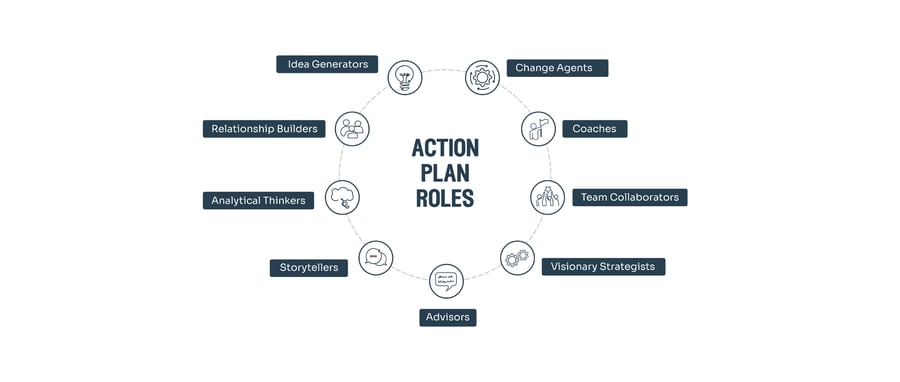
- Using a shared online or in-person workspace, we first introduce the roles graphic (i.e., role wheel) to participants. Without reading the role descriptions, we ask team members to locate where they see themselves in a primary role by writing their name on a green sticky note and placing it on the wheel. They are asked to briefly describe why they have chosen this role, and what it animates for them and their leadership. Keep the round tight, and 1-2 sentence descriptions will suffice. This move serves to locate where people are intrinsically drawn to in the work.
- Once the wheel has a single layer of named, green sticky notes applied, we then ask participants to read the role descriptions as provided. They can then 1) move their green sticky note if they desire, and 2) add a second named, amber sticky note on the role they could support with or secondarily occupy. This move serves to illuminate where the group has capacity, and where it doesn’t. This round also calls on participants to briefly share why they have chosen their primary and secondary roles.
- The final move is an open table discussion, allowing participants to note where capacity is strong, where the group may have redundancy, and where the group may need to fill gaps.
As with many of our tools, this approach yields both product (the project roles, and related gaps, are well articulated and process. Regarding process, through discussion of both individual strengths and group capacities, participants come to see how collaboration and negotiated project positioning can be adaptive, inclusive, creative and strategically compelling when initiating work.
Assets
Role Wheel

Role matrix
|
role
|
description |
primary role |
secondary role |
|
Idea Generators
|
I’m creative, visionary, and innovative. I excel in roles where I contribute to idea generation sessions, innovation, and strategic development. |
||
|
Storytellers
|
I’m a communicator, persuasive speaker, and compelling storyteller. I help articulate the vision, convey key messages, and inspire others to take action through effective storytelling and communication strategies. |
||
|
Visionary Strategists
|
I bring long-term perspective, strategic thinking skills, and the ability to articulate a compelling vision. I can guide the development of clear goals and roles that align with overarching priorities. |
||
|
Change Agents
|
I am adaptable and comfortable navigating uncertainty. I play a crucial role in guiding groups through transformational initiatives, navigating resistance, and fostering a culture of continuous improvement. |
||
|
Analytical Thinkers
|
I’m detail-oriented and adept at solving complex problems. I contribute by identifying patterns, analyzing data, understanding and improving processes, and making data-driven decisions to optimize plan execution. |
||
|
Advisors
|
I can leverage specialized knowledge and experience. Advisors review information, analyze data, and give advice. I offer specialized guidance, recommendations, and feedback. |
||
|
Team Collaborators
|
I can build consensus, facilitate group discussions, and foster teamwork. I can contribute significantly in roles that involve cross-functional collaboration, team building, and facilitation of spaces where diverse perspectives are valued and collaboration thrives. |
||
|
Relationship Builders
|
I am empathetic, people-orientated, and inquisitive. I play a vital role in fostering collaboration, leading engagement, conducting outreach, cultivating partnerships, and building support for the action plan. |
||
|
Coaches
|
I am empathetic, patient, and experienced at asking questions and providing guidance. I can cultivate talent, support the development and autonomy of others, and foster the confidence and growth mindset essential for complex, collaborative work. |
|
|